|
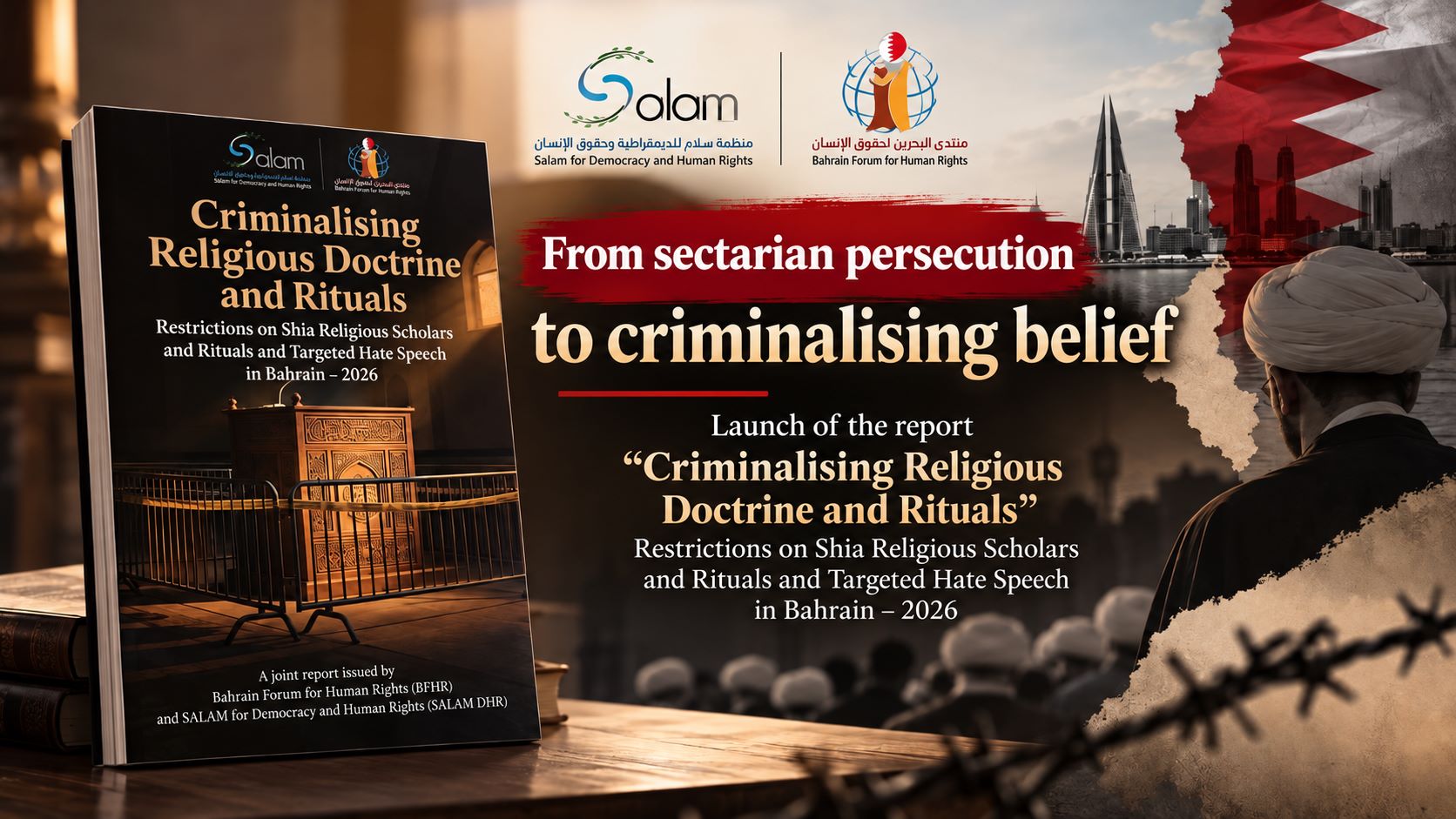
SALAM for Democracy and Human Rights (SALAM DHR) and the Bahrain Forum for Human Rights (BFHR) have launched a joint report, "Criminalising Religious Doctrine and Rituals", which documents the restrictions imposed on Shia religious scholars and religious rituals, as well as the hate speech directed against them in Bahrain during 2026. The report was officially launched during a virtual human rights seminar held on Monday, 12 October 2026. The session focused on the report’s key findings and discussed the escalation of violations against freedom of religion and belief in Bahrain—specifically what the report describes as the “transformation of religious practices and rituals into targets for security and judicial prosecution”. The report provides a comprehensive human rights and legal analysis of violations affecting Shia religious scholars, religious institutions, and religious rituals in Bahrain. It covers four main areas: the prosecution of religious scholars, hate speech and sectarian incitement, restrictions on the observance of Ashura, and interference in the administration of the Jaafari Endowments (Awqaf). 64 Shia religious scholars were arrested between March and August 2026, including 44 who were detained on a single day, on 9 May. Detainees were subjected to torture, ill-treatment, and coercion to extract confessions, alongside restrictions on fair trial guarantees and the rights of the defence. The report warns against the dangerous practice of treating religious beliefs and practices—such as adherence to religious authority, the payment of khums (religious dues), and enrolment in hawza (seminary) studies—as grounds for suspicion or evidence of criminal wrongdoing. There is an urgent necessity to distinguish the exercise of legitimate religious rights from establishing criminal liability for specific acts. Approximately 150 arrests in Bahrain were linked to the Ashura season, involving minors, religious scholars, preachers, rawadid (religious chanters), and administrators of ma’tams (religious assembly halls). Restrictions were imposed on Hussaini processions, the display of Shia banners and slogans, and the holding of religious gatherings. Furthermore, 103 processions or ma’tams were cancelled due to restrictions enforced from July 2026 onwards. The report also highlights an escalation in hate speech and incitement against Shia religious scholars. Based on an analysis of 94 posts on "X" (formerly known as Twitter), it identifies patterns of sectarian stigmatisation, accusations of treason, calls for exclusion and the revocation of citizenship, and, in some instances, even incitement to violence. The report also addressed the restructuring of the Jaafari Endowments (Awqaf) in 2026, along with the accompanying administrative measures and circulars that imposed restrictions on the observance of religious rituals. These included limiting certain activities within ma’tams, restricting Husayni processions, and regulating the use of loudspeakers. These measures raise serious concerns regarding the independence of religious institutions and religious groups’ ability to manage their own affairs and practice their rituals. The report concludes that these practices are not isolated incidents; they constitute a cumulative pattern of restrictions on freedom of religion or belief. It ranges from the targeting of religious leaders to the curtailment of religious observances and the exertion of control over religious institutions and their endowments—all of which threaten rights guaranteed under Article 18 of the International Covenant on Civil and Political Rights. SALAM DHR and BFHR recommend that Bahraini authorities release individuals who have been arbitrarily detained for their religious or political views and stances. It further urges the authorities to conduct independent investigations into allegations of torture and ill-treatment, ensure fair trials, and lift discriminatory restrictions on religious rituals. Additionally, the report calls for an independent review of cases involving religious scholars and religious observances that occurred in 2026, and for ensuring the institutional independence of the Jaafari Endowments. It also urges the Bahraini government to invite relevant United Nations mechanisms—including the Special Rapporteur on freedom of religion or belief—to visit Bahrain to examine the state of religious freedoms and the documented violations. The launch seminar featured contributions from Baqer Darwish, President of the Bahrain Forum for Human Rights; Sayed Yusuf Al-Muhafadha, a human rights consultant at SALAM DHR and Ebtisam Al-Saegh, SALAM DHR’s network coordinator. It also included a recorded statement by Moroccan human rights defender Abdelilah Benabdeslam, coordinator of the Moroccan Coalition for Human Rights Organizations. The session was moderated by Ghina Rabaai, BFHR’s monitoring officer, with simultaneous interpretation provided in English. Launching this report is part of broader human rights efforts to document violations and strengthen international accountability. It underscores that freedom of religion is not limited to the right to hold a belief; it also encompasses the freedom to practice that belief, perform religious rituals, and independently manage religious institutions, free from discrimination. Protecting religious freedom requires ensuring that individuals and groups can practice their beliefs and rituals—publicly and collectively—without fear of arrest, prosecution, or administrative interference that would effectively strip this right of its substance. The report further calls for an end to practices in Bahrain that criminalise religious identity and restrict the observance of religious rituals. To read and download the report "Criminalising Religious Doctrine and Rituals", click here |