|
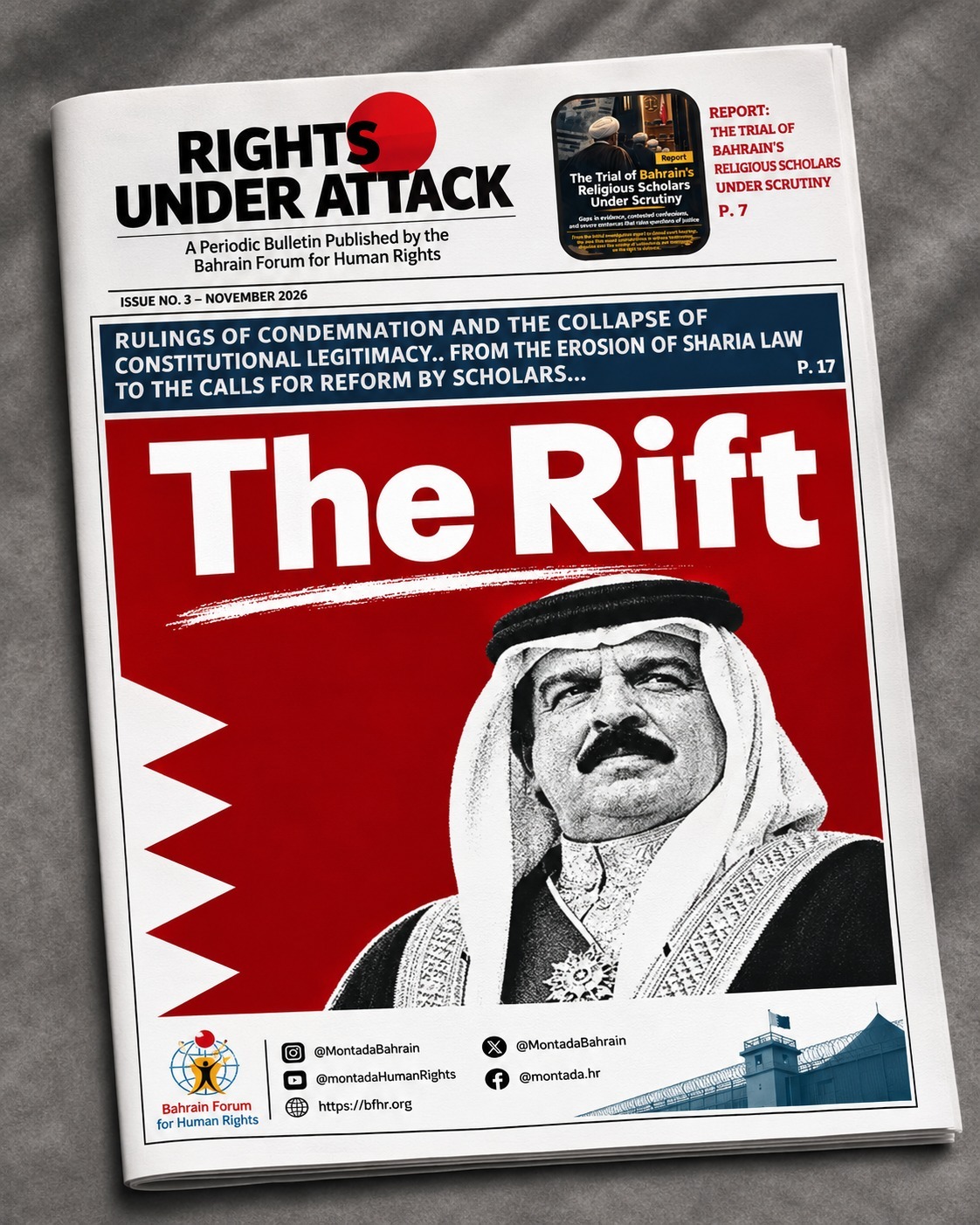
To read the full issue: Click Here The bulletin characterizes the judicial verdicts issued against dozens of clerics and activists on November 16, 2026, as a pivotal milestone in a prolonged trajectory of political and human rights crises. Titled "From False Promises of Reform to the Trial of Religious Scholars," the report examines the transformations Bahrain has undergone since the King assumed power in 1999, culminating in the mass trial of 69 citizens. According to the publication, 64 of the defendants were sentenced to life imprisonment, while the remaining five received 15-year prison terms. From Reconciliation to Political Estrangement
The report reviews the early years of King Hamad’s reign, when Bahrain witnessed steps toward political openness—including the release of detainees, the return of exiles, and the abolition of the State Security Court—before the promulgation of the 2002 constitution without opposition consensus became a central point of contention regarding the distribution of powers and the authority of elected institutions.
It notes that the participation of the Al-Wefaq National Islamic Society in the 2006 parliamentary elections, and its winning of 18 out of 40 seats in 2010, failed to produce genuine political partnership, leaving the underlying causes of dispute unresolved. According to the report, the events of 2011 marked a decisive turning point, as demands for reform, equality, and political participation escalated into a human rights crisis that further eroded trust between the authorities and segments of Bahraini society. The Rift Extends to Religious Institutions
The report states that the repercussions of the crisis were not confined to political activity, but extended to religious institutions and prominent clerical figures—marked by the dissolution of the Islamic Ulama Council in 2014, Al-Wefaq in 2016, and the National Democratic Action Society (Wa’ad) in 2017. It also highlights the revocation of Ayatollah Sheikh Isa Ahmed Qassim’s citizenship in June 2016 and the subsequent sit-in in the Diraz area, which ended with a security operation in May 2017, describing these events as key milestones that deepened concerns over the independence of the Shia religious establishment. Additionally, the report points to the 2018 political and civil isolation laws, which restricted the participation of opposition figures and members of dissolved political societies. The Trial of Clerics: A New Phase in the Rift
The report links these developments to the 2026 mass trial, arguing that the case escalated tensions to a new level by targeting dozens of religious scholars and individuals associated with religious activities.
It documents human rights concerns regarding the integrity of confessions, defense guarantees, restrictions on attending court hearings, and the inclusion of religious activities and practices within the scope of the charges.
The report stresses the necessity of subjecting these allegations to independent scrutiny to ensure the verification of evidence and adherence to fair trial guarantees. The third issue of the bulletin features four investigative reports, a news report, two analytical articles, and an editorial—all examining the trial of Bahraini clerics and its political and human rights ramifications, while shedding light on the growing rift between the authorities and the Shia community, as well as challenges related to freedom of belief, judicial safeguards, and equal citizenship. |