|
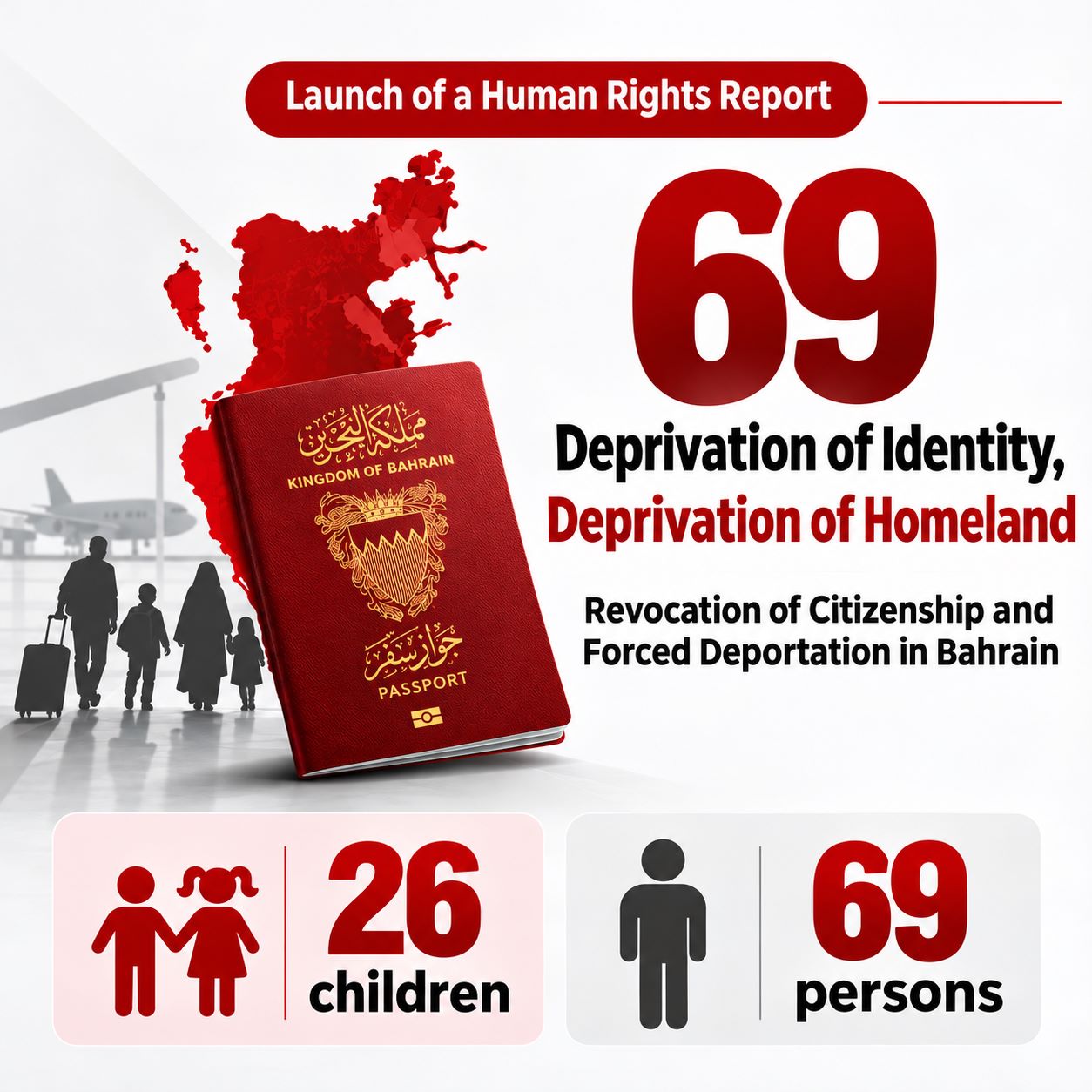
Three Human Rights Organisations Launch Report “Deprivation of Identity, Deprivation of Homeland” on Citizenship Revocation and Forcible Deportation in Bahrain To Read and Download the Full Report, Click Here SALAM for Democracy and Human Rights (SALAM DHR), the Bahrain Forum for Human Rights (BFHR), and Bahraini Institution for Victims of Denationalization and Statelessness (WATAN) convened a webinar on Friday, 6 November 2026, to launch a human rights report documenting the nationality revocation decisions issued in April 2026 and their resulting human rights violations and legal, humanitarian, and social consequences affecting dozens of Bahraini citizens and their families. The report, jointly produced by SALAM DHR, BFHR, abd WATAN draws on human rights monitoring, legal analysis, official data, and documented testimonies from affected individuals. It documents the Bahraini authorities’ decision of 27 April 2026 to revoke the nationality of 69 people, including 26 children, the youngest a 19-day-old infant girl. The decision also extended to family members of those targeted. The report explains that the decision was issued amid regional escalation in 2026, with the Bahraini authorities relying on allegations that the report's authors consider politically motivated and framed in vague terms, without presenting individualised judicial evidence establishing the responsibility of all those affected. The report questions the legal basis and proportionality of these measures, highlighting the absence of publicly disclosed individualised evidence, effective opportunities to appeal, and adequate judicial safeguards. Documenting Violations Beyond Nationality Revocation The report documents a series of measures following the nationality revocations, including the confiscation of passports and identity cards, allegations that some affected individuals were coerced into signing documents relating to their departure from the country, and requirements that they bear their own travel expenses. It also documents forcible deportations, family separation, and the loss of legal and livelihood stability. The report further examines cases of individuals forced to leave Bahrain without valid national identity documents or guarantees of return, leaving them facing uncertainty regarding their legal status and their ability to obtain protection and lawful residence in the countries to which they were compelled to relocate. It warns of the far-reaching consequences of these measures for children, women, and older persons, particularly regarding their rights to identity, education, healthcare, family life, and freedom of movement, alongside the risks of statelessness and the long-term deprivation of fundamental rights. Ghina Rebai: Citizenship Is a Fundamental Right, Not an Instrument of Punishment During the report launch webinar, Ghina Rebai, Head of Monitoring and Documentation at the Bahrain Forum for Human Rights, addressed the constitutional and legal implications of the nationality revocation decisions, particularly their extension to children and family members. She questioned what act an infant could possibly commit to be accused of disloyalty, or what political position a child barely three weeks old could hold, arguing that these decisions transform citizenship from a legal bond and a fundamental right into an instrument of punishment. Rebai outlined the constitutional guarantees of individual responsibility for punishment, the presumption of innocence, separation of powers, and judicial independence under Articles 20, 32, and 104 of Bahrain's Constitution, stressing that these principles must not be disregarded under the pretext of protecting national security. She also highlighted Bahrain's obligations under the Convention on the Rights of the Child, particularly the prohibition against punishing children on the basis of their parents' activities or opinions and the requirement to give primary consideration to their best interests in decisions affecting their lives and futures. Rebai warned that the consequences of nationality revocation extend beyond the loss of official documents to include forced displacement, family separation, disruption of livelihoods, and deprivation of social protection, threatening individuals' fundamental rights and stability. Sayed Youssef Al-Muhafdha: Nationality Revocation Is Part of a Systematic Policy For his part, Sayed Youssef Al-Muhafdha, Researcher and Adviser at SALAM for Democracy and Human Rights, highlighted the violations of international law associated with nationality revocation and overt forcible deportations, as well as the involvement of other countries in facilitating deportation operations, including Azerbaijan. He called on United Nations bodies and the European Union, particularly the United Kingdom, to fulfil their responsibilities in this regard, noting that the UK funds human rights-related projects in Bahrain using taxpayers' money. He further urged the United Kingdom to leverage its political and trade relations, as well as bilateral agreements, to press Bahrain to comply with its obligations under international human rights law. Al-Muhafdha concluded his intervention by emphasising that those deprived of their nationality are not merely numbers or statistics. Behind every individual is a human story, a personal history, and a lifetime of memories. Providing historical context, the report noted that the April 2026 decisions were not isolated incidents but rather a continuation of the policy of nationality revocation practiced in Bahrain since 2012. According to monitoring and documentation conducted by the three organisations, 985 individuals were stripped of their nationality between 2012 and 2019, before citizenship was restored to 551 of them in 2019. According to the report, including subsequent cases, the total number of individuals whose Bahraini nationality has not been restored has reached 504. Legal Findings and Calls for Urgent Action The report concludes that the documented measures raise serious concerns regarding violations of Bahrain's constitutional guarantees and its obligations under international human rights law, particularly the prohibition of arbitrary deprivation of nationality, the right to a fair trial and effective judicial remedies, the protection of children's rights, and the prohibition of discrimination and forcible expulsion. The report calls on the Bahraini authorities to immediately reverse arbitrary nationality revocation decisions and restore citizenship and official documents to all affected individuals, particularly children who lost their nationality by extension. It also calls for guarantees of the right of those deported to return safely to their homeland. Furthermore, it emphasises the need to subject nationality-related decisions to independent judicial review, guarantee the rights of defence and appeal, review relevant legislation, conduct independent investigations into allegations of coercion, ill-treatment, and discrimination, and provide reparations to victims and their families. The organisations participating in the report launch also called on relevant United Nations mechanisms and the international community to continue monitoring the situation, press Bahrain to fulfil its international human rights obligations, and take effective measures to prevent further cases of statelessness, including encouraging accession to relevant international conventions. The launch of the joint report forms part of the three organisations' efforts to document the situation of affected individuals, highlight the legal and humanitarian dimensions of nationality revocation, and put forward practical recommendations to address its consequences. These efforts reaffirm that the right to nationality is intrinsically linked to identity, belonging, and the enjoyment of all other fundamental rights. 12 November 2026 |