|
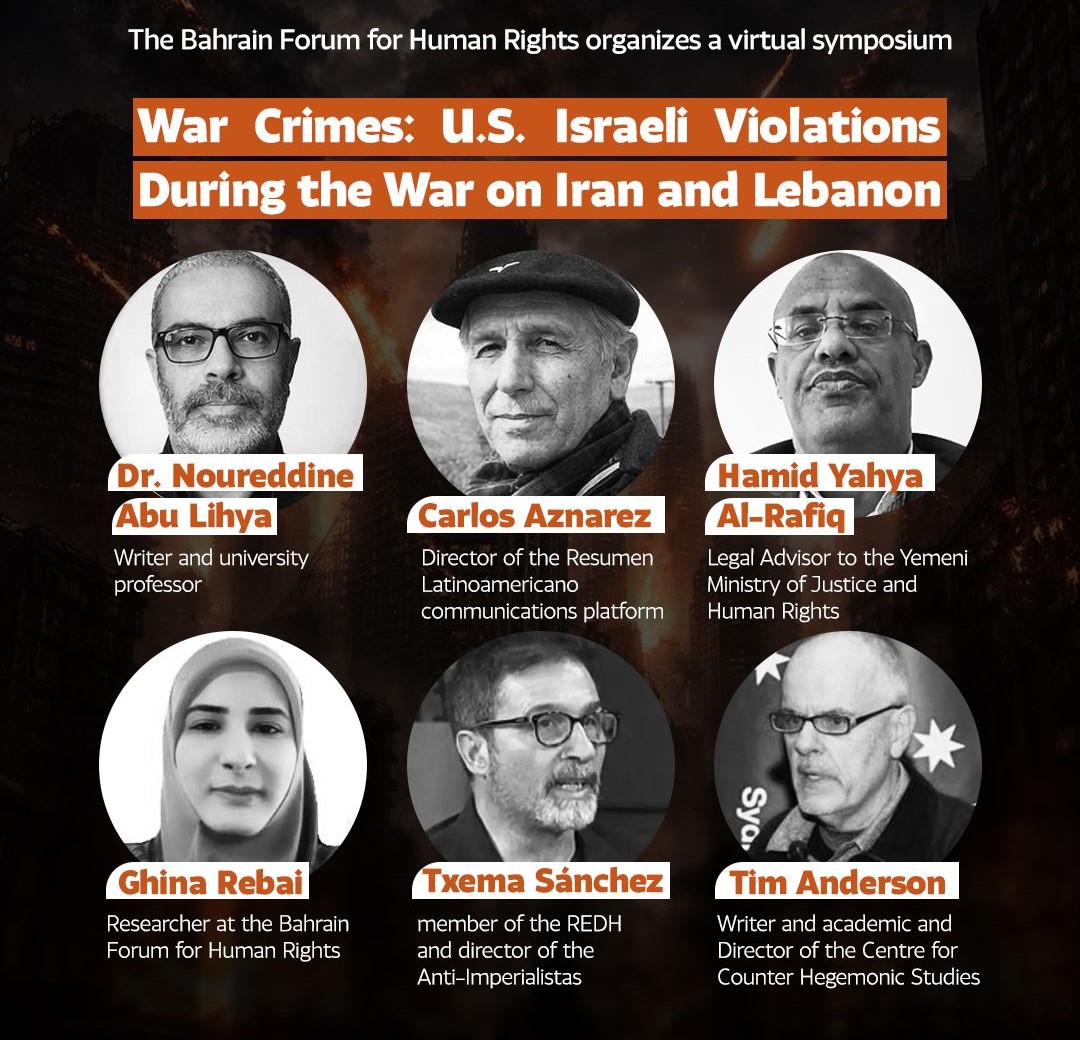
The Bahrain Forum for Human Rights (BFHR) organized a virtual seminar titled “War Crimes: U.S.–Israeli Violations During the War on Iran and Lebanon” on April 19, in solidarity with the peoples of Iran and Lebanon in light of the grave violations and war crimes committed against them by the U.S. and Israeli aggression. The seminar featured interventions by Ghina Rebai, a researcher at BFHR; Hamid Yahya Al-Rafiq, Legal Advisor to the Yemeni Ministry of Justice and Human Rights; Tim Anderson, writer, academic, and Director of the Center for Counter-Hegemonic Studies; Dr. Nour El-Din Abu Lahya, Algerian writer and university professor; Txema Sánchez, member of the World Network of Intellectuals in Defense of Humanity (REDH) and Director of the “Anti-Imperialism” website; and Carlos Aznárez, Director of the “Resumen Latinoamericano” communications platform (press, radio, and television), writer, and international political analyst. To watch the seminar in Arabic, click here Rebai: The crisis of disregard for civilian lives in armed conflicts is linked to a deeper crisis that has become nearly entrenched in the mechanisms for implementing international law, which have gradually been reduced to merely formal frameworks. In her remarks, Ghina Rebai, researcher at BFHR, presented a summary of statistics on the most prominent war crimes committed by the U.S.–Israeli aggression against the Islamic Republic of Iran and Lebanon, and highlighted the international laws violated through the commission of these acts. She concluded by pointing to the escalation of security repression by certain Gulf governments—particularly Bahrain—against citizens who expressed opposition to the U.S.–Israeli war. This has taken the form of widespread campaigns of arbitrary arrest and enforced disappearance, culminating in the killing under torture of Bahraini citizen Mohammed Al-Mousawi. Al-Rafiq: Previous decisions issued by the international community have failed to halt the U.S.–Israeli war crimes committed in Lebanon and Iran. In his intervention, Hamid Yahya Al-Rafiq, Legal Advisor to the Yemeni Ministry of Justice and Human Rights, stated that horrific crimes and blatant violations of the rules and provisions of international humanitarian law—that the international community has “celebrated” since 1948—are being committed against Iran and Lebanon by the United States in service of “Israel.” Meanwhile, the international community adopts a position of neutrality between the victim and the perpetrator and turns a blind eye to these crimes. After presenting a summary of some of the most prominent crimes committed by the U.S.–Israeli aggression, Al-Rafiq referred to previous decisions issued by international mechanisms, including the International Court of Justice, aimed at prosecuting those involved from the Zionist entity in war crimes. He noted that these decisions were not implemented; rather, those who issued them were subjected to sanctions by the United States. He also pointed to United Nations Security Council resolutions that have yielded no effective results in protecting civilians from war crimes committed by the Zionist entity. Anderson: Attempts to colonize Lebanon and destroy Iran rank among the most serious war crimes in history and are being carried out within the framework of the “Greater Israel” project and the “New Middle East” vision, aimed at achieving full domination through a military command called CENTCOM, headquartered in Qatar In his intervention, Tim Anderson, writer, academic, and Director of the Center for Counter-Hegemonic Studies, stated that the war being waged by the United States and Israel against Iran and Lebanon is described as the supreme crime. It is a crime against peace that encompasses all forms of crimes committed under its umbrella—from the last century to the present aggression, which lacks any clear justification. It includes the assassination of Iranian leaders and leaders and members of resistance movements, and extends to full-scale invasions carried out repeatedly by Israel in its capacity as an advanced base of the United States since the 1970s. It is now attempting to reoccupy southern Lebanon and annex it to northern Palestine. It also includes economic warfare, which the United States describes as sanctions but which are, in United Nations terminology, known as unilateral coercive measures—constituting grave violations of human rights. Abu Lahya: The United States violates agreements and cannot be trusted to uphold human rights. In his intervention, Dr. Nour El-Din Abu Lahya, Algerian writer and university professor, stated: “Western civilization presents itself as founded upon values, charters, and covenants. However, in the current period, contradictions have become evident in the United States’ dealings with other countries, most notably Iran. Iran had concluded an agreement with the United States under the auspices of the United Nations, only for Trump to later withdraw from it. Is this consistent with human rights as enshrined in treaties and covenants? Trump then responded to Israel on two successive occasions by striking Iran while negotiations were ongoing in 2025, and struck it again in 2026. This demonstrates that the United States cannot be trusted. Likewise, the Zionist entity concluded a ceasefire agreement with Lebanon, yet violations continued despite the agreement’s entry into force. When Israel and the United States conclude agreements, they expect only the other party to implement them while exempting themselves. This pattern persists even when agreements are made under the auspices and sponsorship of numerous countries, as in the case of the Gaza agreement, which was never implemented. Despite this, Trump emerged from the agreement session speaking arrogantly, and some countries even proposed awarding him the Nobel Peace Prize. There is also the issue of assassinations, including the assassination of a spiritual leader and religious authority (marja?) for a large sect of Muslims, who holds a status comparable to that of the Pope in Rome. They boast of having killed this religious authority, of killing the leader of the resistance in Lebanon, His Eminence Sayyed Hassan, and of assassinating many religious scholars in Lebanon and Iran, as well as prominent and respected figures.” Sánchez: Peace will not be achieved except through the complete defeat of imperialism, and the vanguard of victory is manifested in Iran and Lebanon. In his intervention, Txema Sánchez, member of the World Network of Intellectuals in Defense of Humanity (REDH) and Director of the “Anti-Imperialism” website, stated: “We are facing a decisive confrontation in the region between two geostrategic blocs—one represented by the declining Zionist imperial structure and Europe, and the other by the regional anti-imperialist axis in West Asia, which represents the Global South. The United States is deploying its Zionist offensive arm in a comprehensive war to generate chaos in the region; however, if it fails, it may allow for the collapse of the Zionist entity as a state. This could open the way for the liberation of the peoples of the region, particularly the Palestinian people, and could make West Asia a cradle of shared progress and renewed civilization, paving the way for social transformations similar to the Iranian experience in other parts of the world. For these reasons, it is essential for the peoples of the global anti-imperialist axis—an axis that is becoming increasingly consolidated and clear—to recognize that indifference to the struggles of others, without understanding that they are part of our own struggle, will result in darkness reaching us all. The enemy, characterized by its annihilatory nature, exerts pressure to isolate us from our immediate reality.” Aznárez: This is no longer an ordinary war, but an assault on humanity. It cannot be ignored, nor can it be claimed that it does not concern us. The Israeli aggression against Lebanon seeks to destroy all the foundations of life. In his intervention, Carlos Aznárez, Director of the “Resumen Latinoamericano” communications platform (press, radio, and television), writer, and international political analyst, stated that “the brutal aggression being waged by what may be described as an alliance of death—the alliance between the United States and Israel, which many of us have come to refer to as the ‘Epstein network’—represents Donald Trump’s attempt to evade trial and imprisonment following the exposure of his criminal past and present, portraying him as a child abuser, immoral individual, and criminal. As for the Islamic Republic of Iran, it is defending itself and possesses additional strength in doing so, supported by its people and by millions of Iranians prepared to sacrifice their lives in defense of national sovereignty.” He added: “The United States does not adhere to any agreement it concludes, and Israel adheres even less. However, Iran has not attacked anyone; it is a brotherly country with its allies, yet it demonstrates firmness in the face of aggression.” Aznárez further emphasized the issue of Israeli aggression against Lebanon, stating: “It is an aggression that seeks to destroy civilian populations, hospitals, schools, and all the foundations of life. What must be underscored is the need to support peoples who resist, such as Iran and the Palestinian people, who are subjected to ongoing genocide in Gaza and the West Bank, where homes are burned and children are killed while the world remains inactive. These crimes may extend to other countries in pursuit of resource control, and therefore they must be brought to an end.” |