|
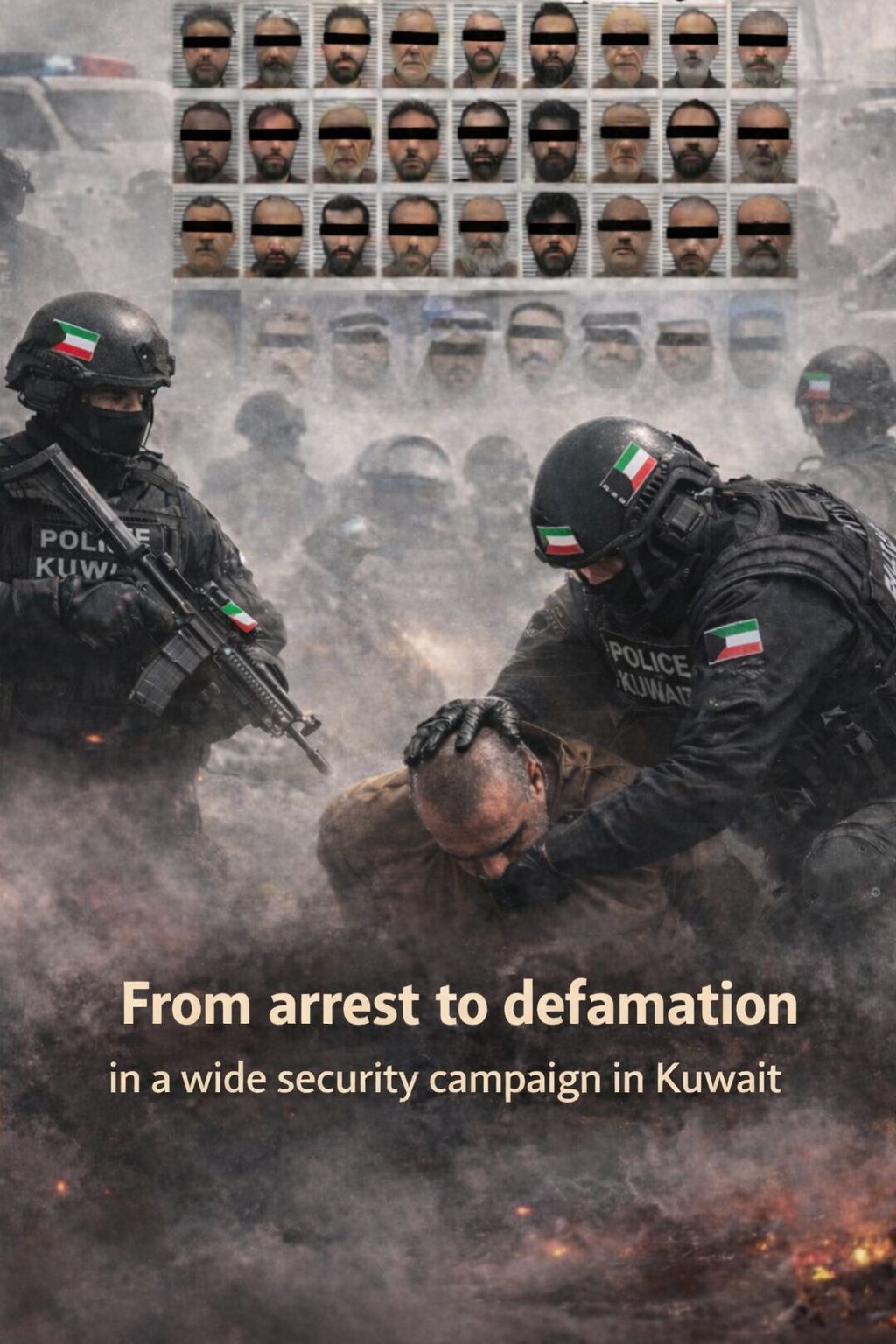
From Arrest to Defamation in Kuwait A Brief Human Rights Report on Violations Linked to the Security Crackdown in Kuwait By Bahrain Forum for Human Rights Introduction The Bahrain Forum for Human Rights (BFHR) has followed the recent security escalation in Kuwait, along with the official narrative presented in Ministry of Interior Statement No. (21), issued on April 11, 2026. The statement put forward an official account that effectively presumes the guilt of the detained or defamed victims before the requirements of justice have been met, and before the public, the detainees’ families, and their lawyers have been granted access to basic legal safeguards. This constitutes a blatant violation of fair trial guarantees and underscores the politicization of the legal procedures being applied. This statement cannot be treated as a mere security announcement; rather, it represents a political discourse of a pre-emptively accusatory nature, reflecting a dangerous shift in how official bodies are handling security-related cases—at the expense of justice and the rule of law in the State of Kuwait. The following are key human rights observations: First: Refuting the Official Narrative – Violation of the Presumption of Innocence The Ministry of Interior’s statement was issued in a decisive tone, using terms such as “foiling a plot,” “financing terrorist entities,” and “illegal acts,” without presenting verifiable evidence or providing detailed information about the allegations against each accused. The evidence shown in the video footage also does not correspond to the nature of the charges. This pattern of discourse: - Constitutes a direct violation of the principle of the presumption of innocence
- Turns the executive authority into a body that issues media-based accusations
- Pre-empts the judiciary and affects its independence
Moreover, publishing the names and photographs of the accused—including well-known parliamentary, political, religious, and academic figures—amounts to prior public shaming and undermines their right to a fair trial. Second: Political and Incendiary Nature of the Campaign Available information indicates that the campaign has targeted prominent figures from across Kuwaiti society, the majority of whom are Shiite citizens. These include: Former Members of the Kuwaiti National Assembly - Sayed Adnan Sayed AbdulSamad (77 – detained)
- Ahmed Lari (71 – detained)
- Hani Hussein Ali Shams (56 – detained)
- Mubarak Saleh Hassan Al-Najada (57 – detained)
- Dr. Khalil Abdullah Ali Abdullah Abal (61 – detained)
Religious Scholars - Ayatollah Sheikh Hussein Al-Maatouq (in absentia)
- Sheikh Mahdi Anwar Salman Al-Hazim (in absentia)
- Sheikh Ali Mansour Habib Boushehri (in absentia)
- Sheikh Mahmoud Ahmed Lari (in absentia)
- Sheikh Hashem Fadel Al-Rasheed (detained)
- Sheikh Ahmed Sami Mohammed Abdullah Al-Ameer (detained)
- Sheikh Hamed Hadi Mohammed Al-Saleh (detained)
- Sheikh Ibrahim Saleh Youssef Al-Mazeedi (detained)
- Sheikh Mahdi Mohammed Abbas Ashkanani (detained)
- Sayed Mohammed Sayed Hassan Al-Husseini (in absentia)
- Sheikh Hassan Baloushi (detained)
Lawyers - Mohammed Hamza Abbas Ali Sarkhouh (detained)
- Ali Salah Salman Al-Hazim (detained)
- Jaafar Abdulkarim Juma Abdullah Hussein (detained)
Academics - Professor Jaafar Abbas Haji (detained)
- Dr. Basel Hussein Dashti (in absentia)
- Dr. Sayed Ahmed Mustafa Al-Mousawi (Kuwait University – detained)
- Yousef Hassan Ghadanfari (Kuwait University – in absentia)
- Hassan Ahmed Abdullah Al-Attar (detained)
- Jassem Mohammed Ghadanfari (detained)
This broadening of targeted groups, along with the sectarian specificity, reinforces the conclusion that the case goes beyond a criminal framework into a systematic political targeting of the Shiite presence in Kuwait’s public and political life. Third: A Dangerous Conflation Between Charitable Work and Terrorism The official statement relies on vague language that links fundraising “under religious labels” to terrorism financing, without a clear legal distinction.
This conflation: - Opens the door to criminalizing civil and religious activities.
- Threatens freedom of association and charitable work.
- Instills fear within civil society and among donors.
The absence of detailed evidence further reinforces the impression that the security narrative is one-sided and lacking in transparency. Fourth: Serious and Large-Scale Violations Available documented information indicates the occurrence of a series of serious violations, including: - Arbitrary arrest and enforced disappearance: Large arrest campaigns involving hundreds of individuals, with no precise information on numbers or detention locations.
- Torture and coerced confessions: The use of coercion and torture during interrogations, according to statements from some victims’ relatives, in clear violation of international standards.
- Raiding homes and terrorizing civilians: Night raids conducted without judicial warrants, humiliating women and preventing them from covering themselves in front of unrelated men, mass arrests inside homes, and spreading fear among children.
- Violation of privacy: Searching phones at checkpoints and in public spaces, photographing private conversations, and interrogating individuals based on sectarian affiliation.
- Targeting lawyers: Preventing access to detainees and arresting some lawyers.
These practices constitute serious violations of multiple rights, including the rights to personal liberty and security, privacy, physical and psychological integrity, defense, and non-discrimination. Fifth: Revocation of Nationality as a Tool of Pressure The statement’s reference to some of the accused as “individuals whose nationality has been revoked” raises serious concerns about the use of nationality as a tool for political punishment, security pressure, and demographic engineering. This contradicts international norms prohibiting arbitrary deprivation of nationality. Sixth: A Troubling Legal Context – Toward an Exceptional Legal Framework This campaign comes in the context of: - The reinstatement of State Security courts and prosecution.
- Amendments to counterterrorism laws.
- Removal of legal constraints such as statutes of limitation.
- The enactment of these measures in the absence of a parliament.
This raises concerns about the establishment of an exceptional legal framework used to provide formal legitimacy to political repression. Seventh: Human Rights Assessment Baqer Darwish, chairman of the Bahrain Forum for Human Rights (BFHR), affirms that “all these cases are political, and their foundations point to the invalidity of the procedures.” This assessment is supported by several indicators, including prior media condemnation, the absence of publicly disclosed strong evidence, the broad targeting of well-known figures, and the timing in relation to political and regional tensions, including the aggression against the Islamic Republic of Iran. Translation of the graphic: Ministry of Foreign Affairs
State of Kuwait Circular Regarding the Inclusion of Individuals and/or Entities on the National List To all companies and financial institutions in the State of Kuwait With reference to Ministerial Decision No. 176/2025, concerning the executive regulations of the committee for implementing Security Council resolutions issued under Chapter VII, related to combating terrorism and preventing the proliferation of weapons of mass destruction. We would like to inform you that the committee has approved the inclusion of the following names on the national list:
Ministerial Decision No. 176/2025: Expansion of the List to Include Prominent Figures On April 12, 2026, the Kuwaiti Ministry of Foreign Affairs issued a circular concerning the inclusion of individuals and/or entities on the national list, addressed to all companies and financial institutions in Kuwait. It referred to Ministerial Decision No. 176/2025 regarding the executive regulations of the committee responsible for implementing Security Council resolutions under Chapter VII related to combating terrorism and preventing the proliferation of weapons of mass destruction. Under this decision, a number of prominent public figures were added to the national list, including former members of parliament such as Hani Hussein Ali Shams, Mubarak Saleh Hassan Al-Najada, and Khalil Abdullah Ali Abdullah Abal. It also included well-known religious figures such as Sheikh Ali Mansour Habib Boushehri, Sheikh Mahdi Anwar Salman Al-Hazim, Sheikh Hamed Hadi Mohammed Al-Saleh, Sheikh Ibrahim Saleh Youssef Al-Mazeedi, Sheikh Mahdi Mohammed Abbas Ashkanani, and Sheikh Ahmed Sami Mohammed Abdullah Al-Ameer. Additionally, the list included several lawyers, such as Mohammed Hamza Abbas Ali Sarkhouh, Jaafar Abdulkarim Juma Abdullah Hussein, and Ali Salah Salman Al-Hazim, as well as academics and scholarly figures, including Professor Jaafar Abbas Haji, Dr. Sayed Ahmed Mustafa Al-Mousawi, and Hassan Ahmed Abdullah Al-Attar. This reflects the broad scope of the decision, which has impacted a wide spectrum of the political, religious, legal, and academic elite within Kuwaiti society. Human Rights Commentary This broad inclusion of public figures from diverse fields on a security-based list raises serious human rights concerns, particularly in light of the lack of transparency, the absence of disclosed evidence, and the failure to allow listed individuals to exercise their right to defense or to effectively challenge the decision. Placing former MPs, religious scholars, lawyers, and academics within a single framework—without clear distinctions or detailed factual grounds for each case—heightens concerns about the politicization of listing procedures and their use as a tool to pressure or restrict specific groups. When such decisions are issued administratively and accompanied by parallel media or security campaigns, they constitute a direct violation of the presumption of innocence, leading to pre-judgment outside the judicial process. This undermines judicial independence and affects the fairness of any subsequent proceedings. The risks are compounded by the absence of clear and transparent mechanisms for appeal or judicial review, contrary to international standards that require effective legal safeguards, particularly when such measures carry serious consequences for reputation, liberty, and civil rights. This decision constitutes a flagrant violation of fundamental principles of justice and fair trial guarantees, foremost among them the presumption of innocence. This is evidenced by the fact that a large number of public figures were included on a list of a serious punitive nature without the disclosure of clear evidence or enabling those concerned to exercise their right to defense or to effectively challenge the decision. The transformation of administrative procedures into tools of pre-judgment, and the association of individuals’ names with terrorism cases without a transparent and independent judicial process, amounts to a direct undermining of the rule of law. It also sets a dangerous precedent that allows the executive authority to bypass the judiciary and issue implicit judgments that harm individuals’ reputations and civil rights. The broad scope of the listings—including former members of parliament, religious scholars, lawyers, and academics—also points to a discriminatory pattern and reflects the politicization of legal procedures. This raises serious concerns about the use of counterterrorism frameworks as tools of pressure or restriction targeting specific groups within society. Such an approach is inconsistent with international standards, which require clear evidence, independent decision-making, and effective mechanisms for review and challenge. The continued reliance on such lists, in the absence of genuine judicial oversight and robust procedural safeguards, not only constitutes an individual violation of rights but also risks establishing an exceptional legal framework that undermines confidence in the justice system and weakens the protection of fundamental rights and freedoms. Translation of the graphics: Image 1 Al-Qabas Cases of Revocation of Kuwaiti Nationality - If a person enters military service in a foreign state without the permission of the Government of Kuwait.
- If he works in the interest of a foreign state while it is in a state of war with Kuwait, or when diplomatic relations with it are severed.
- If he joins an organization that seeks to undermine the social, economic, or political system of Kuwait.
Image 2 If a final judgment is issued convicting him of crimes affecting loyalty to the country or undermining the social, economic, or political system. - If he deliberately adds to a nationality file—his own or that of another person—any individual who is not one of his children or descendants.
- Revocation of nationality is limited, in such cases, to the person concerned alone.
Decree-Law No. 52 of 2026: An Indicator of Expanding the Use of Collective Nationality Revocation Decree-Law No. 52 of 2026, amending the Kuwaiti Nationality Law, raises serious human rights concerns—not only in terms of its content but also the context in which it was issued. While it refers to achieving a “balance” between sovereignty and humanitarian considerations, the amended provisions grant the executive broad and vague powers to withdraw or revoke nationality, using ambiguous terms such as “supreme state interest” or “undermining the system,” without clear definitions or objective, reviewable standards. Exempting nationality decisions from judicial oversight by classifying them as “acts of sovereignty” constitutes a fundamental breach of the rule of law and undermines the right to litigation and effective remedy. This contradicts international standards that require all administrative decisions—especially those affecting fundamental rights—to be subject to independent judicial review. The seriousness of this decree increases when viewed alongside the documented violations outlined in this report, including arbitrary detention, defamation, and the absence of fair trial guarantees. The amendments appear to provide legal cover for these practices rather than limiting them. Expanding nationality revocation to cases based on “indications” or security assessments, with the possibility of extending consequences to family members, amounts to collective punishment prohibited under international law. It also opens the door to using nationality as a tool for political punishment or discrimination. Moreover, linking fundamental civil rights to a legal status that can be withdrawn by administrative decision deepens legal insecurity and risks transforming nationality from a regulated legal framework into an instrument of political control, undermining confidence in the justice system and weakening the protection of fundamental rights in the state. Eighth: Recommendations BFHR calls on the Kuwaiti authorities to: - Immediately release prisoners of conscience.
- Disclose the number and locations of detainees.
- Guarantee the right to defense and access to legal counsel.
- End torture and investigate violations.
- Stop defamation and incitement in the media.
- Uphold the presumption of innocence.
- End arbitrary revocation of nationality.
- Review exceptional laws.
- Allow independent international bodies to monitor legal and judicial processes.
- Hold accountable those responsible for violations accompanying arrest, investigation, and detention.
With regard to individuals affected by the violations arising from Ministerial Decision No. 176/2025, BFHR recommends the following: - The immediate removal of all names listed in this report from the national list, due to serious violations in the listing process, including arbitrary detention, media defamation, and denial of the right to defense, which undermine the legal validity of these decisions.
- Restoring reputation and providing reparations: taking official steps to compensate those arbitrarily listed, including restoring their reputation, removing legal and media consequences, and ensuring non-repetition.
- Opening an independent investigation into the circumstances of the listings: establishing an independent and impartial committee to assess the legality of the listing procedures, examine possible political or discriminatory motives, and hold those responsible accountable.
- Ensuring that national listing mechanisms are not used as punitive tools outside the judicial process or as instruments of political or social pressure.
Regarding the nationality revocation decree, BFHR recommends the following: - Suspending provisions that allow withdrawal or revocation of nationality based on vague wording.
- Ending the immunity of nationality decisions from judicial review by amending provisions that classify them as “acts of sovereignty,” and ensuring their full subjection to judicial oversight, thereby guaranteeing the right to effectively challenge such decisions and to an effective remedy.
- Prohibiting collective penalties related to nationality: repealing any provision that allows the effects of the withdrawal or revocation of nationality to extend to family members, and ensuring individual responsibility only, in line with international standards prohibiting collective punishment.
- Ensuring that nationality is not used as a tool of political or security-related punishment by establishing strict legal safeguards to prevent the use of nationality revocation in the context of political or security cases, particularly in light of the documented violations outlined in this report.
- Protecting individuals from statelessness by refraining from any measures that would render a person stateless, in accordance with international human rights standards.
- Conducting a comprehensive review of legislative amendments with independent participation: calling for the opening of an inclusive national and legal dialogue, involving independent experts and human rights organizations, to reassess the recent amendments and ensure their compatibility with the Constitution and international standards.
– 04 – 14 2026 www.bfhr.org [email protected] [email protected] |