|
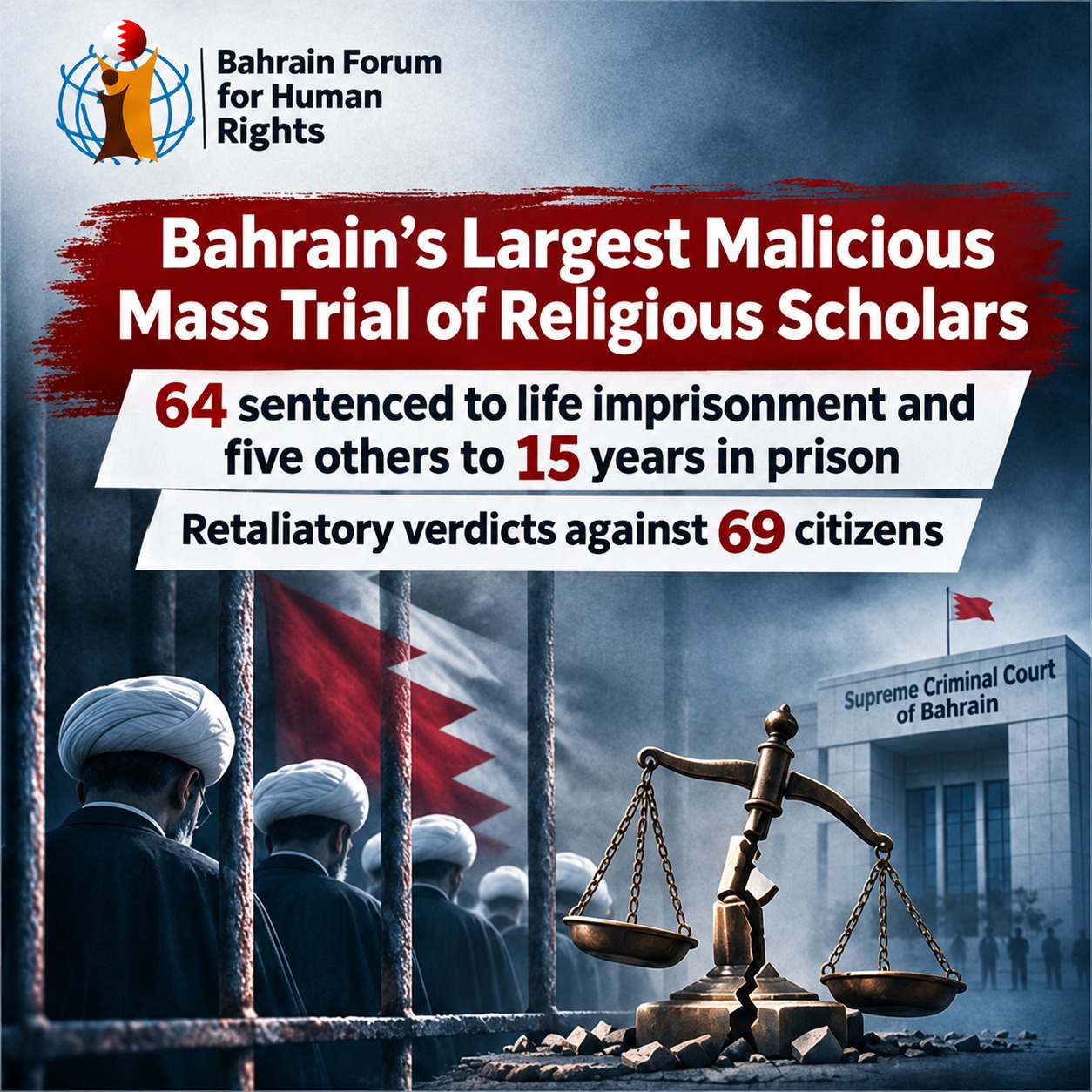
The Bahrain Forum for Human Rights (BFHR) condemns the unjust verdicts issued by Bahrain’s High Criminal Court on Monday, November 16, 2026, against 69 defendants, including 61 Shia religious scholars and eight activists. The court sentenced 64 defendants to life imprisonment and five others to 15 years in prison, including sentences handed down in absentia. Among those sentenced is His Eminence Ayatollah Sheikh Isa Ahmed Qassim, the leader of Bahrain’s Shia community. BFHR considers today’s verdicts a devastating blow to religious freedoms and political rights in Bahrain’s modern history.
The Forum views these verdicts as a dangerous escalation in the authorities’ policy of settling political scores with the Shia religious establishment under the guise of judicial proceedings. The sentencing hearing took place amid heightened security measures. Sources who spoke to BFHR reported that security forces had sealed off all entrances to the courthouse. The scholars’ families and relatives were prevented from attending the hearing, while others were allowed to enter. The scholars themselves were not allowed to appear in court in person and instead attended the hearing remotely via video link. These measures continued the restrictions on public access to the proceedings and the rights of the defense.
The sudden decision to move the sentencing date forward from November 22 to November 16, 2026, with lawyers notified only by telephone, further highlights the political manipulation of this case. The decision coincided with regional military escalation and renewed security tensions. The Forum considers this a reflection of the authorities’ exploitation of these circumstances to expedite the verdicts and settle political scores at home. BFHR’s position that the trial is invalid is not based solely on political objections. Rather, it rests on a record of violations throughout the arrests, investigations, and trial proceedings. These include accounts of physical and psychological torture; cruel, inhuman, and degrading treatment; threats of violence against detainees and their families; and statements and signatures obtained under duress. Other violations include denying some defendants access to lawyers during questioning, restricting defense lawyers’ access to case files and evidence, requiring defendants to participate in hearings via video link, and preventing families and human rights organizations from attending court hearings. These are not minor procedural irregularities. They are serious violations that undermine the foundations of justice and turn the trial into a tool of political persecution and retaliation. The detained religious scholars include teachers of advanced Bahth al-Kharij classes at Islamic seminaries, Friday and congregational prayer leaders, and seminary teachers and directors. They also include preachers, members of the Islamic Scholars Council — the highest religious body of Bahrain’s Shia community — and representatives of senior religious authorities based in the holy cities of Najaf and Qom. According to the Forum’s documentation, 50 of the 56 defendants were questioned without their lawyers present, despite prior requests for their lawyers to attend. BFHR also documented interrogations conducted at night and records showing identical interrogation times for different defendants questioned by the same investigator. Several scholars denied making statements attributed to them and filed complaints alleging coercion and ill-treatment. More seriously, defense lawyers were denied complete copies of the case file. Their requests for original materials relating to complaints of abuse were also not properly fulfilled. How can courts impose sentences that deprive people of their liberty for the rest of their lives when serious questions remain about the reliability of confessions, the circumstances in which they were obtained, and the defendants’ right to challenge the evidence against them? The problems extend beyond procedural violations to the very basis of the charges. Conflicting accounts placed the establishment of the alleged organization in 2004, 2014, 2018, and 2019. The testimony of the intelligence officer was inconsistent regarding how information had been collected. He was also unable to provide detailed answers to a large proportion of the questions put to him, while the defense was prevented from completing its questioning on key aspects of the alleged events. At the same time, ordinary religious activities were used to build a case involving allegations of terrorism and foreign ties. These activities included teaching Islamic jurisprudence, delivering sermons, collecting religious dues, and communicating with senior religious authorities. A joint statement published by Human Rights Watch and other international human rights organizations on November 10, 2026, reinforced findings previously documented by BFHR. Among the most disturbing accounts was the testimony of Sayyid Musa Jawad Al-Wadai. He reported being threatened with the rape of his daughter, subjected to electric shocks, beaten, stripped of his clothes, and threatened with deportation from Bahrain along with his family. Despite the seriousness of these allegations, the Special Investigation Unit closed his complaint, citing insufficient evidence. It had failed to obtain surveillance camera footage on the grounds that it had been automatically deleted. The dismissal of torture complaints, the failure to secure evidence, and the continuation of the trial based on interrogation records whose reliability has been challenged reveal a system that protects those responsible for abuses. These practices also demonstrate how investigative bodies, the Public Prosecution, and the judiciary are being used to serve the political authorities rather than uphold justice. The case is made even more serious by the trial in absentia of prominent religious figures, including His Eminence Ayatollah Sheikh Isa Ahmed Qassim. These proceedings have been marked by secrecy and a lack of transparency regarding the defendants’ legal representation, their ability to present statements, and their right to challenge the evidence. This secrecy comes alongside reports that defendants were forced to sign statements they were not allowed to read. There are also reports that identical passages appeared in confessions attributed to different individuals. What kind of justice can be delivered through a trial whose details are concealed and in which the rights of the defense are restricted? These practices reflect a politicized judicial process that has lacked the basic safeguards of justice from the outset. More seriously, the case goes beyond the prosecution of religious scholars to target the religious identity of Bahrain’s Shia community, along with its institutions and religious authorities. Sermons, religious writings, religious education, rituals, funds associated with religious obligations, and ties with senior religious authorities have all been used as grounds for criminal charges. This approach amounts to criminalizing peaceful religious practices and conflating sectarian identity with political loyalty. It also represents an attempt to place the religious and social lives of Shia citizens under security control. In light of the above, BFHR reiterates its firm rejection of this politically motivated and malicious prosecution and condemns all verdicts issued in the case. The Forum views them as part of an ongoing policy of persecution and exclusion and considers them a flagrant violation of the safeguards guaranteed by Bahrain’s Constitution. These include Article 19, which prohibits torture and coercion and renders confessions obtained through such means invalid, and Article 20, which guarantees the presumption of innocence and the rights of the defense. The verdicts also violate Article 14 of the International Covenant on Civil and Political Rights, which sets out the guarantees of a fair trial. BFHR holds the Bahraini authorities, including their security and judicial institutions, politically and legally responsible for these violations and for the continued targeting of religious scholars. The Forum also holds them responsible for the serious consequences of these practices for social peace and national stability.
Accordingly, the Bahrain Forum for Human Rights calls for:
1. The immediate overturning of all convictions in this case and the dropping of all related politically motivated charges. BFHR also demands the immediate and unconditional release of all religious scholars and citizens arbitrarily detained for peacefully exercising their religious rights or expressing their political and intellectual views. It further calls for an end to the prosecution of religious figures being tried in absentia. These measures must ensure that the case is brought to a close and is no longer used as a means of continued punishment and persecution.
2. Holding the Bahraini authorities fully accountable, both politically and legally, for the violations committed against religious scholars and detainees. Those responsible for torture, coercion, threats, assaults, ill-treatment, and the concealment of evidence must be brought to justice. Accountability must not be limited to those who directly carried out the abuses. It must also extend to anyone who ordered, participated in, or facilitated these violations, or obstructed investigations into them, in accordance with their legal responsibility.
3. Urgent and effective action by the international community, particularly the United Nations Human Rights Council and the Office of the United Nations High Commissioner for Human Rights, to address the documented violations. The Forum calls for the activation of available international accountability mechanisms and for international pressure to overturn the verdicts and end arbitrary prosecutions.
4. Urgent intervention by the United Nations Special Procedures and international and regional human rights organizations, particularly the UN Special Rapporteurs on torture, the independence of judges and lawyers, and freedom of religion or belief. BFHR calls on them to monitor the case and investigate violations associated with the investigation and trial. This should include examining the rights of defendants tried in absentia, safeguards for the defense, and restrictions on public access to court hearings.
5. Immediate protection for all religious scholars and detainees in prison, ensuring that they are not subjected to assaults or retaliatory measures, particularly those who disclosed torture and coercion before the court. The Forum calls for security agencies and prison authorities to be held directly responsible for their physical and psychological safety. Detainees must also be allowed to communicate with their families and lawyers and receive necessary medical care without arbitrary restrictions.
6. An end to impunity and the establishment of an independent international accountability mechanism to examine violations committed against religious scholars and Shia citizens. This mechanism should investigate torture, coercion, threats, and collective punishment, and identify individual and institutional responsibility. It must also ensure victims’ rights to redress, compensation, and reparations. Violations involving the Public Prosecution and judicial authorities must be subject to effective, independent oversight.
7. An end to policies of religious and sectarian discrimination and targeting, including security interference in the affairs of religious institutions, Hussaini mourning halls (ma’atim), religious endowments (awqaf), and Hussaini rituals. BFHR also calls for guarantees that religious scholars and citizens can freely engage in religious activities and peacefully express their beliefs and views.
Bahrain Forum for Human Rights
November 16, 2026 |