|
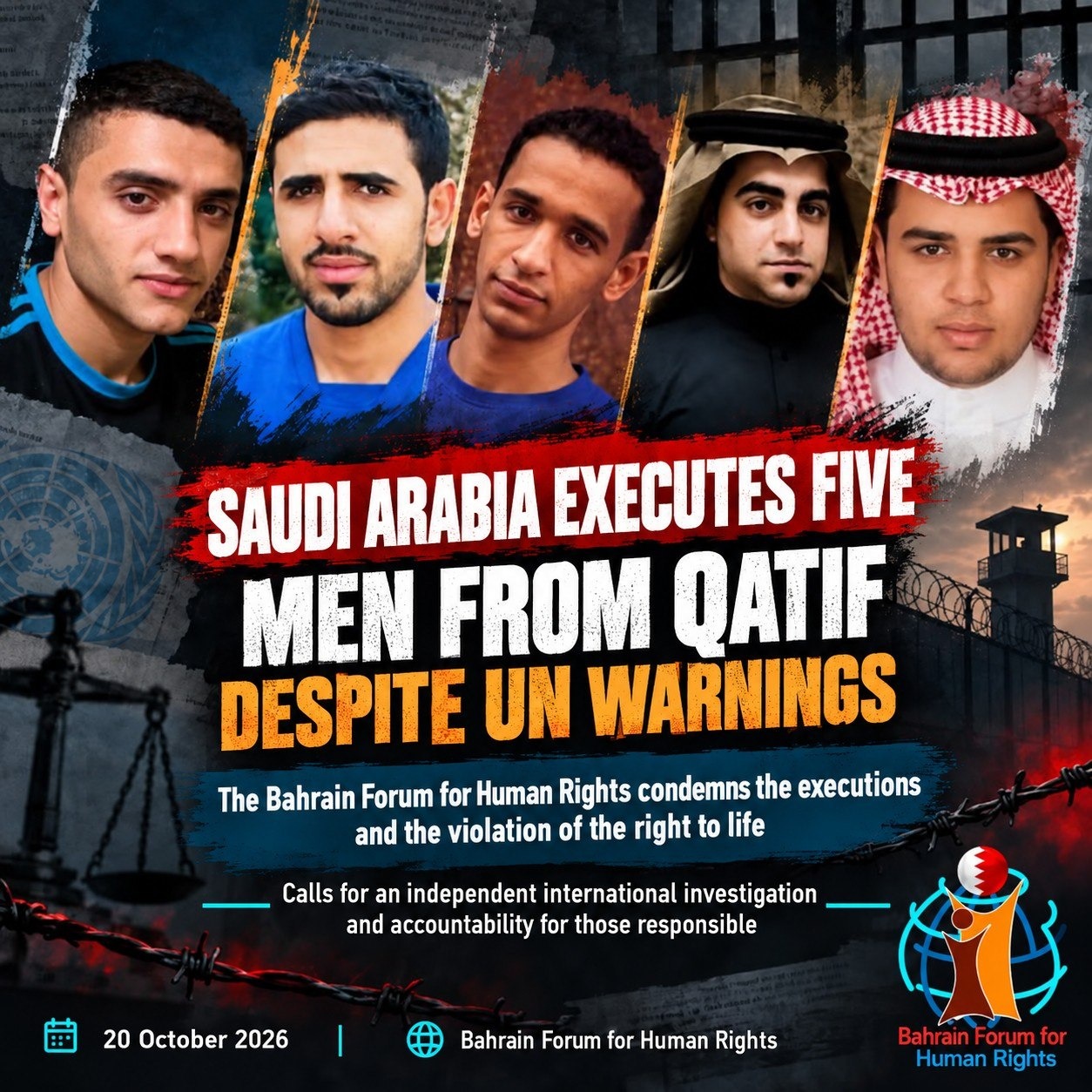
Saudi Arabia Executes Five Men from Qatif Despite UN Warnings
The Bahrain Forum for Human Rights Condemns the Executions as Violations of the Right to Life and Calls for an Independent International Investigation and Accountability
Neither repeated United Nations warnings nor human rights reports documenting serious violations of fair trial guarantees prevented Saudi authorities from carrying out the executions of five men from Qatif on Saturday, October 17, 2026.
The five men were Hassan Zaki Mohammed Al-Faraj, Mohammed Mounir Mohammed Al-Zaher, Ali Abed Rab Al-Hussein Al-Sheikh, Redha Mohammed Ali Al-Abu Abdullah, and Ali Hassan Ahmed Al-Rabeh.
These executions add five more names to Saudi Arabia's growing record of executions, reflecting the authorities' continued disregard for international warnings and exposing the right to life to the irreversible consequences of capital punishment.
The case of Hassan Zaki Al-Faraj is particularly alarming. He was executed under a discretionary (ta'zir) death sentence for acts allegedly committed when he was a child, despite UN Working Group on Arbitrary Detention Opinion No. 71/2024, which found his detention to be arbitrary. UN experts issued renewed warnings on October 9, 2026, just eight days before his execution.
Al-Faraj was arrested in 2017 in connection with his participation in demonstrations and funeral processions when he was 14 and 15 years old. According to human rights documentation, he was subjected to beatings and electric shocks that required repeated hospitalization, held in solitary confinement for three months, coerced into making confessions, and denied access to legal counsel for three years.
His execution constitutes a violation of the Convention on the Rights of the Child and directly contradicts Saudi Arabia's juvenile justice legislation and its official commitments to end executions for offenses committed by minors.
The authorities also executed four other men on the basis of collective terrorism-related allegations, without publishing the judgments or supporting evidence or identifying any act of intentional killing attributed to any of them. This raises serious concerns regarding compliance with international standards, which restrict the death penalty to the most serious crimes.
In response to this grave escalation, the Bahrain Forum for Human Rights (BFHR) strongly condemns the execution of the five men and holds the Saudi authorities fully legally responsible.
The Forum emphasizes that judicial rulings, even when upheld by higher courts, cannot legitimize executions arising from proceedings marred by serious violations of fair trial guarantees.
The execution of Hassan Zaki Al-Faraj for acts allegedly committed during childhood constitutes an arbitrary execution and an unlawful deprivation of the right to life, in clear violation of Article 37(a) of the Convention on the Rights of the Child, which categorically prohibits capital punishment for offenses committed by persons under the age of 18.
The circumstances surrounding the trials and executions of the other four men likewise warrant an independent international investigation and accountability for any violations committed against them.
BFHR further emphasizes that Saudi Arabia's continued use of capital punishment in politically motivated cases, amid documented cases of torture and unfair trials, reflects a broader pattern of repression, intimidation, restrictions on fundamental freedoms, and the silencing of dissent.
The Forum considers that these practices, and the arbitrary deprivation of the right to life they entail, reveal a stark contradiction between the country's human rights record and Crown Prince Mohammed bin Salman's public pledges of reform, openness, and reduced reliance on the death penalty. Such practices undermine official claims of modernization and reform, reducing widely promoted initiatives of openness to a public relations façade that fails to reflect the actual state of rights and freedoms in the country. These executions form part of a concerning increase in the use of capital punishment in Saudi Arabia. Amnesty International documented 356 executions in 2025, compared with 345 in 2024. At least 18 individuals have been executed since 2015 for offenses allegedly committed while they were children. These include Jalal Al-Labbad, executed on August 21, 2025; Abdullah Al-Derazi, executed on October 20, 2025; and Ali Hassan Al-Subaiti, executed on April 9, 2026.
With the execution of Al-Faraj, Saudi Arabia has executed three of the five individuals addressed in UN Working Group Opinion No. 71/2024. Meanwhile, Youssef Al-Munasif and Jawad Qureiris remain at risk of execution, amid reports that Saudi Arabia's Supreme Court has upheld Al-Munasif's death sentence, reflecting the continued disregard for international warnings. In light of these serious developments, the continued implementation of death sentences, and the authorities' failure to heed UN warnings, BFHR calls for the following measures:
1. Conduct an independent international investigation into the arrest, interrogation, prosecution, trial, and execution of the five men. The investigation must examine allegations of torture, coercion, and denial of legal defense guarantees, establish legal and judicial responsibility, and ensure accountability for all those implicated in violations.
2. Immediately revoke all death sentences imposed on Shiite citizens in Saudi Arabia in cases with political backgrounds.
3. Call for immediate intervention by the UN Human Rights Council and the relevant United Nations mechanisms, particularly the Special Rapporteur on extrajudicial, summary or arbitrary executions, the Special Rapporteur on torture, and the Working Group on Arbitrary Detention. These mechanisms should ensure effective follow-up on reported violations and implementation of previous UN recommendations.
4. Immediately revoke the death sentences imposed on Youssef Al-Munasif, Jawad Qureiris, and all other individuals sentenced to death for acts committed while they were children. The authorities must also release those arbitrarily detained and ensure access to effective remedies and reparations for the violations they have suffered.
5. Investigate cases in which convictions relied on confessions extracted under torture or proceedings that failed to uphold the right to an adequate defense. Investigators and judicial officials responsible for substantiated violations must be held accountable, and impunity must end.
6. Make public the full judicial records of the five executed men, including investigation and interrogation transcripts, evidence, confessions, judicial reasoning, and appellate decisions. Independent bodies must be granted access to these materials to assess their compliance with domestic legal guarantees and international human rights standards.
7. Ensure that the victim’s families receive complete information about the circumstances in which the executions were carried out. Return the bodies of their loved ones and allow families to conduct dignified burials. Provide effective remedies, reparations, and compensation for violations committed against the victims and their families.
8. Call on Saudi Arabia to accede to the International Covenant on Civil and Political Rights (ICCPR) and its Second Optional Protocol. The Kingdom must also bring its national legislation and judicial practices into conformity with its international human rights commitments and applicable international standards. Bahrain Forum for Human Rights
October 20, 2026 |