|
Religious Observances Without Processions: New Security Measures Raise Concerns Over Religious Freedom in Bahrain As part of an ongoing policy of restricting freedoms and targeting religious rituals, the Bahraini authorities have banned mourning processions from taking place outside ma'atim (Shiite mourning halls).
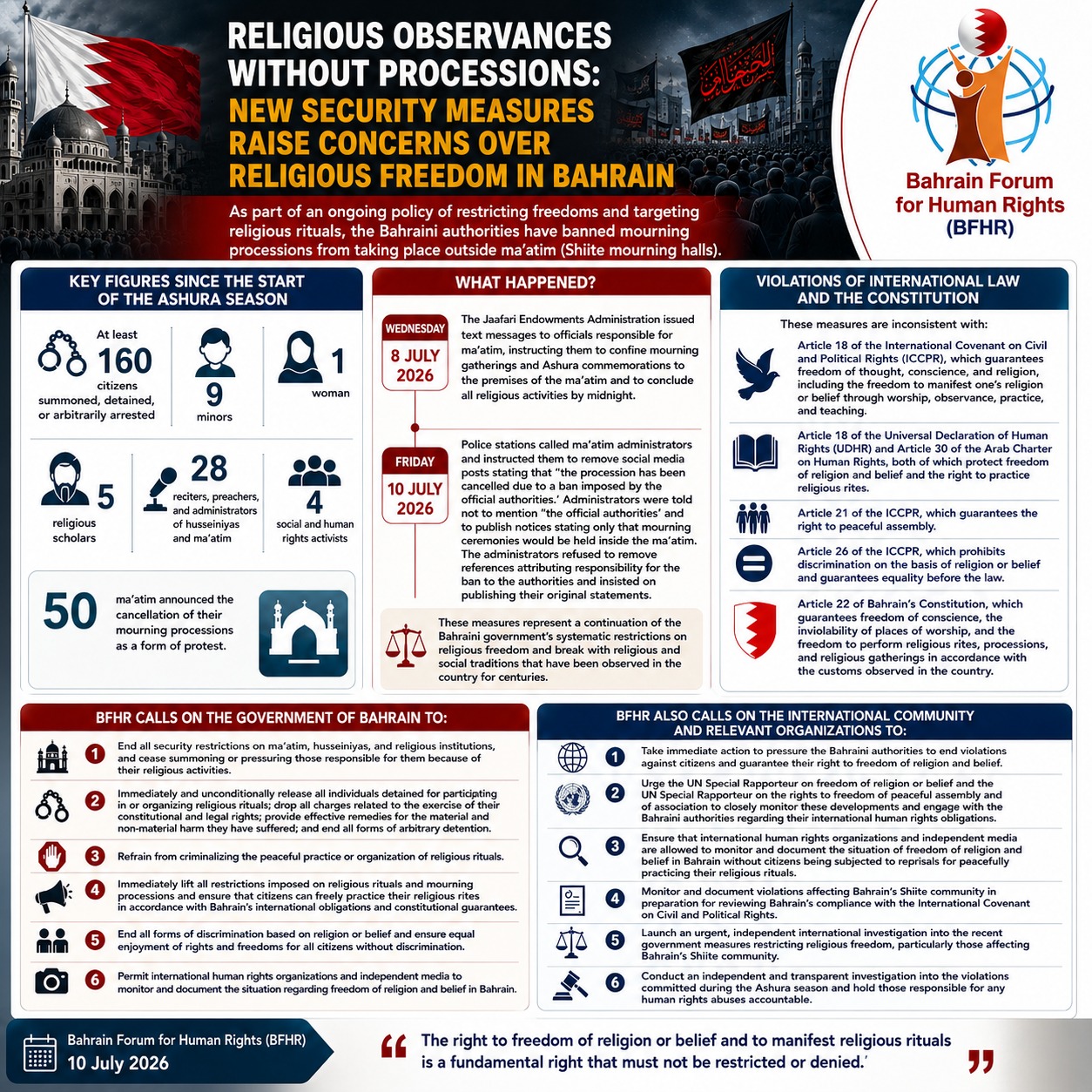
Continuing its systematic campaign of restrictions targeting Bahrain's Shiite community and its religious rituals—a campaign that has intensified amid recent regional tensions—the Jaafari Endowments Administration issued text messages on 8 July 2026 to officials responsible for ma'atim. The messages instructed them to confine mourning gatherings and Ashura commemorations to the premises of the ma'atim and to conclude all religious activities by midnight. These measures represent a continuation of the Bahraini government's systematic restrictions on religious freedom and the right of Shiite citizens to practice their faith. They are inconsistent with Bahrain's constitutional guarantees and break with religious and social traditions that have been observed in the country for centuries.
The Bahrain Forum for Human Rights (BFHR) is closely monitoring developments concerning the official ban on mourning processions outside ma'atim. On the morning of 10 July 2026, administrators of several ma'atim received telephone calls from police stations instructing them to remove social media posts stating that "the procession has been cancelled due to a ban imposed by the official authorities." They were specifically instructed not to mention "the official authorities" and instead to publish notices stating only that mourning ceremonies would be held inside the ma'atim. The administrators refused to remove references attributing responsibility for the ban to the authorities and insisted on publishing their original statements.
Ghina Rebai, BFHR's Monitoring and Documentation Officer, reported that as of the date of this statement, 50 ma'atim had announced the cancellation of their mourning processions as a form of protest, highlighting the growing scope of restrictions on the practice of religious rituals.
BFHR notes that since the beginning of the Ashura season it has documented an escalation in violations of religious freedom and the targeting of Shiite religious commemorations in particular by Bahrain's security authorities. According to its documentation, at least 160 people have been summoned, detained, or arbitrarily arrested, including 9 minors, one woman, five religious scholars, 28 reciters, preachers, and administrators of husseiniyas and ma'atim, and four social and human rights activists. While some have been released, many remain in detention or have been imprisoned.
In addition to these serious violations, BFHR reports that the security forces carried out campaigns of summonses and arbitrary arrests that began during the religious occasions immediately preceding Ashura and continued after the Ashura commemorations had concluded. It also documented raids on residential neighborhoods, the removal of Ashura banners, flags, and all other visible expressions of mourning, heightened scrutiny of the content of religious slogans, and the expansion of the powers granted to security personnel to confront mourning processions. In addition, peaceful demonstrators protesting the removal of religious displays during Ashura were subjected to physical assaults, while security forces used tear gas and excessive force to disperse protesters, resulting in injuries.
The Bahrain Forum for Human Rights considers the continuation of these restrictive and sectarian discriminatory policies—which amount to repression—to be an attempt to impose security control over the independence of religious affairs, contrary to the protections guaranteed under international law. BFHR strongly condemns these decisions and practices.
It emphasizes that these measures violate Bahrain's international obligations, particularly Article 18 of the International Covenant on Civil and Political Rights (ICCPR), which guarantees freedom of thought, conscience, and religion, including the freedom to manifest one's religion or belief through worship, observance, practice, and teaching, individually or collectively, in public or in private. The measures are also inconsistent with Article 18 of the Universal Declaration of Human Rights and Article 30 of the Arab Charter on Human Rights, both of which protect freedom of religion and belief and the right to practice religious rites.
BFHR further notes that Article 21 of the ICCPR guarantees the right to peaceful assembly, while Article 26 prohibits discrimination on the basis of religion or belief and guarantees equality before the law. Moreover, the measures violate Article 22 of Bahrain's Constitution, which provides:
"Freedom of conscience is absolute. The State shall guarantee the inviolability of places of worship and the freedom to perform religious rites, processions, and religious gatherings in accordance with the customs observed in the country."
Based on the above, BFHR calls on the Government of Bahrain to:
1. End all security restrictions on ma'atim, husseiniyas, and religious institutions, and cease summoning or pressuring those responsible for them because of their religious activities.
2. Immediately and unconditionally release all individuals detained for participating in or organizing religious rituals; drop all charges related to the exercise of their constitutional and legal rights; provide effective remedies for the material and non-material harm they have suffered; and end all forms of arbitrary detention.
3. Refrain from criminalizing the peaceful practice or organization of religious rituals.
4. Immediately lift all restrictions imposed on religious rituals and mourning processions and ensure that citizens can freely practice their religious rites in accordance with Bahrain's international obligations and constitutional guarantees.
5. End all forms of discrimination based on religion or belief and ensure equal enjoyment of rights and freedoms for all citizens without discrimination.
6. Permit international human rights organizations and independent media to monitor and document the situation regarding freedom of religion and belief in Bahrain.
BFHR also calls on the international community and relevant organizations to:
1. Take immediate action to pressure the Bahraini authorities to end violations against citizens and guarantee their right to freedom of religion and belief.
2. Urge the UN Special Rapporteur on freedom of religion or belief and the UN Special Rapporteur on the rights to freedom of peaceful assembly and of association to closely monitor these developments and engage with the Bahraini authorities regarding their international human rights obligations.
3. Ensure that international human rights organizations and independent media are allowed to monitor and document the situation of freedom of religion and belief in Bahrain without citizens being subjected to reprisals for peacefully practicing their religious rituals.
4. Monitor and document violations affecting Bahrain's Shiite community in preparation for reviewing Bahrain's compliance with the International Covenant on Civil and Political Rights.
5. Launch an urgent, independent international investigation into the recent government measures restricting religious freedom, particularly those affecting Bahrain's Shiite community.
6. Conduct an independent and transparent investigation into the violations committed during the Ashura season and hold those responsible for any human rights abuses accountable.
Bahrain Forum for Human Rights
10 July 2026 |