|
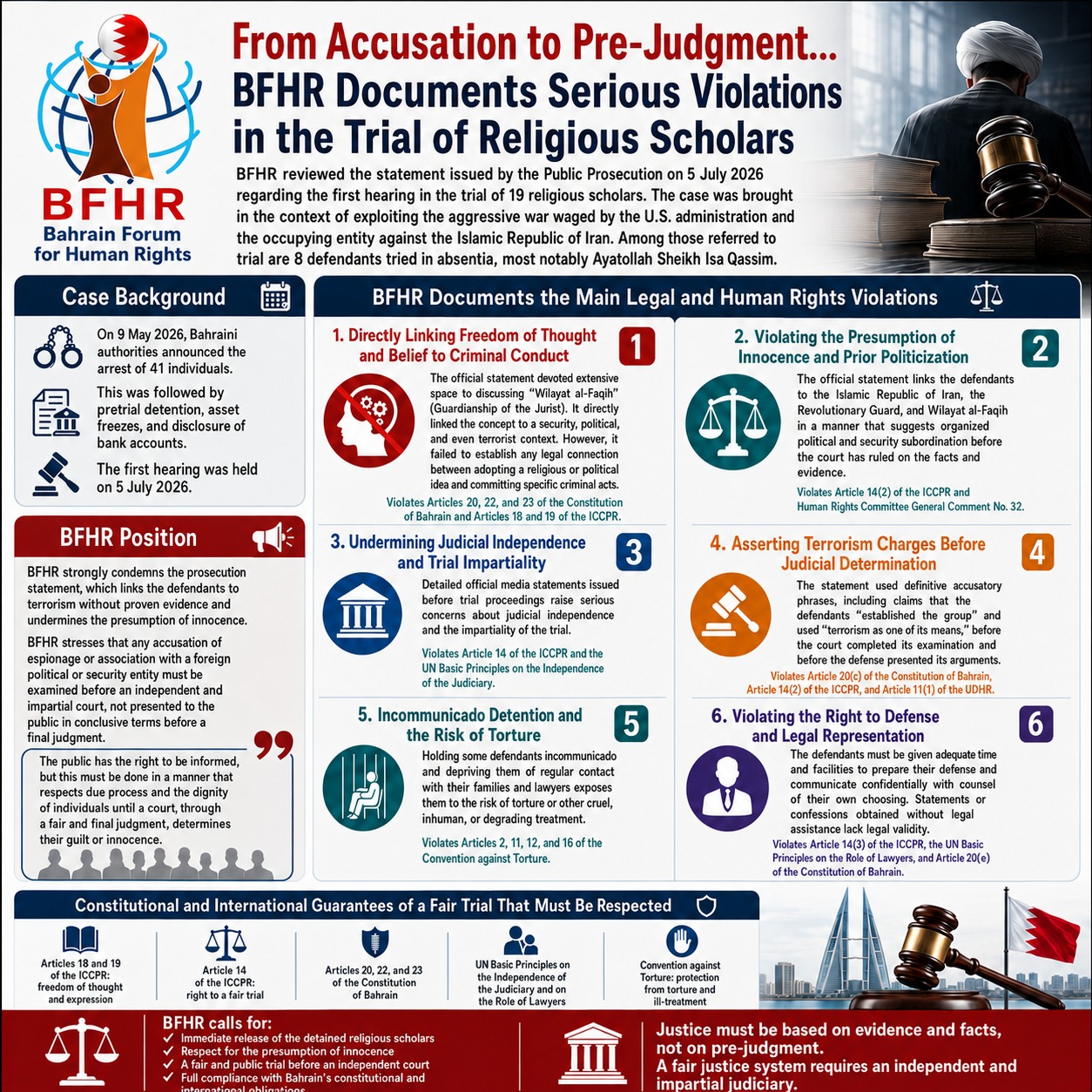
From Accusation to Pre-Judgment: BFHR Documents Serious Violations in the Trial of Religious Scholars The Bahrain Forum for Human Rights (BFHR) has reviewed the statement issued by the Public Prosecution on 5 July 2026 regarding the first hearing in the trial of 19 religious scholars. The case was brought in the context of exploiting the aggressive war waged by the U.S. administration and the occupying entity against the Islamic Republic of Iran. In this case, 19 religious scholars were referred to trial, including eight defendants tried in absentia, most notably the leader of Bahrain’s Shiite community, His Eminence Ayatollah Sheikh Isa Qassim.
This trial is an extension of measures that began on 9 May 2026, when Bahraini authorities announced the arrest of 41 individuals. These measures were followed by pretrial detention, asset freezes, and disclosure of bank accounts.
Upon reviewing the Advocate General’s statement, serious legal and human rights violations were found. The official statement contained definitive accusations and language that undermine the presumption of innocence and affect the defendants’ right to a fair and impartial trial, especially as the case remains under judicial consideration. The defense has not yet exhausted its right to challenge the evidence and respond to the contents of the indictment file. BFHR strongly condemns the issuance and content of this statement. BFHR warns of the grave danger of linking the defendants to terrorism without proven evidence. It also stresses that adopting definitive accusatory narratives does not absolve the authorities of their obligation to strictly uphold constitutional and international guarantees. These include the guarantees of a fair trial, the principle of legality in criminal law, the presumption of innocence, freedom of thought, conscience and religion, and freedom of opinion and expression. In this context, BFHR believes that the course of the case and the measures taken against the defendants reveal several legal and human rights violations, summarized as follows:
First: Directly linking freedom of thought and belief to criminal conduct
The official statement devoted extensive space to discussing “Wilayat al-Faqih” (Guardianship of the Jurist). It directly linked the concept to a security, political, and even terrorist context. However, it failed to establish any legal connection between adopting a religious or political idea or position and committing specific acts criminalized by law and proven before an independent and impartial court.
The statement also used broad and vague terms that are open to wide interpretation and inconsistent with reality, such as “destabilizing security,” “hostile ideas,” “entrenching ideology,” and “dominating places of worship.”
BFHR emphasizes that criminalizing thought or belief, or portraying it in itself as evidence of a security threat, violates constitutional and international guarantees related to freedom of thought, conscience and religion, and freedom of opinion and expression, particularly Articles 20, 22, and 23 of the Constitution of Bahrain, as well as Articles 18 and 19 of the International Covenant on Civil and Political Rights.
Second: Violating the presumption of innocence and engaging in pretrial politicization
The official statement links the defendants to the Islamic Republic of Iran, the Revolutionary Guard, and Wilayat al-Faqih in a manner that suggests the definitive existence of organized political and security subordination before the court has ruled on the facts and evidence.
This approach violates Article 14(2) of the International Covenant on Civil and Political Rights, which provides that everyone charged with a criminal offense has the right to be presumed innocent until proven guilty according to law.
The Human Rights Committee has also affirmed, in General Comment No. 32, that public authorities, including law enforcement agencies and public prosecutors, must refrain from making statements suggesting the guilt of defendants before a final judgment is issued, as such statements influence public opinion and undermine the impartiality of the court.
BFHR stresses that any accusation of espionage or association with a foreign political or security entity must be subject to the highest standards of investigation and proof. Such accusations must also be examined before an independent and impartial court, rather than presented to the public in conclusive terms before a final judgment has been issued. Third: Undermining judicial independence and the impartiality of the trial
BFHR believes that the issuance of detailed media statements by the executive authority and the Public Prosecution, setting out the official narrative of the case before the start of trial proceedings, raises serious concerns regarding respect for the independence and impartiality of the judiciary.
The Human Rights Committee has affirmed that the guarantee of a fair trial is not limited to the institutional independence of judges, but also requires avoiding any official practices or statements that may create a preconceived impression among the public or the court regarding the defendants’ responsibility.
In this context, official media coverage that presents accusations as established facts, while publishing extensive details about alleged events, may undermine judicial impartiality. This constitutes a violation of one of the fundamental standards of a fair trial under Article 14 of the International Covenant on Civil and Political Rights, as well as the Basic Principles on the Independence of the Judiciary adopted by the United Nations in 1985.
Fourth: Asserting terrorism charges before judicial determination
The statement used definitive accusatory phrases such as “the defendants established the group,” “some of them communicated with the State of Iran,” “working to change the constitutional system,” and “using terrorism as one of its means.”
However, the court has not yet completed its examination of the case, and the defense has not presented its arguments or objections regarding the charges brought against the defendants.
The problem is not limited to the description of acts attributed to the defendants; it also extends to attributing broader intentions and objectives to them, such as seeking to change the constitutional system, harm the interests of the Kingdom, and destabilize security. Such elements may not be asserted publicly before they are subjected to evidence, pleadings, and independent judicial assessment.
BFHR emphasizes that describing the defendants, including religious scholars, within the framework of a “terrorist organization” in an official statement issued by the authorities before a final judgment has been rendered constitutes a violation of the principle of respect for the presumption of innocence. It also violates several legal provisions, including Article 20(c) of the Constitution of the Kingdom of Bahrain, Article 14(2) of the International Covenant on Civil and Political Rights, and Article 11(1) of the Universal Declaration of Human Rights.
Fifth: Incommunicado detention and the risk of torture and ill-treatment
BFHR affirms that holding some defendants incommunicado and depriving them of regular contact with their families and lawyers is among the most serious factors that expose them to the risk of torture or other cruel, inhuman, or degrading treatment.
Articles 2, 11, 12, and 16 of the Convention against Torture require States Parties to take effective measures to prevent physical and psychological torture, including effective oversight of places of detention and protection against isolation from the outside world.
BFHR believes that holding the first trial hearing virtually, without the effective presence of defense lawyers or the defendants’ families, raises serious concerns about the condition of the detainees.
Sixth: Violating the right to defense and legal representation
Article 14(3) of the International Covenant on Civil and Political Rights provides that every accused person has the right to adequate time and facilities to prepare their defense and to communicate with counsel of their own choosing.
The Basic Principles on the Role of Lawyers, adopted by the United Nations in 1990, further affirm that every detained person has the right to contact a lawyer without delay, and no later than forty-eight hours from the time of detention, and that all communications between a lawyer and their client must remain fully confidential.
Article 20(e) of the Constitution of the Kingdom of Bahrain guarantees the accused person’s right to seek the assistance of a lawyer in felony cases. This is a constitutional guarantee that may not be diminished under any pretext related to the nature of the accusation.
BFHR stresses that any statements or confessions obtained while the accused is deprived of legal assistance, or as a result of coercion or psychological or physical pressure, lack legal validity.
Seventh: Treating religious books and money as indicators of terrorism
The official statement referred to the seizure of books, publications, and money, presenting them as evidence of the criminal activity attributed to the defendants.
BFHR emphasizes that possession of books, including religious, intellectual, or political works, does not in itself constitute a criminal act. Likewise, possession of money is not evidence of a crime unless a direct link is proven between the funds and unlawful activity, in accordance with the law and through a fair trial.
BFHR believes that presenting these seized items to the public as indicators of “terrorist activity” before they have been judicially assessed directly undermines freedom of thought, conscience and religion. It also creates a climate of preemptive intimidation against anyone exercising the same rights related to reading, belief, and religious or intellectual expression.
Eighth: Sectarian discrimination and politicized targeting
BFHR believes that referring a large number of senior scholars from the Shiite community to trial in a single case, and linking their religious institutions and discourse to terrorist activities, raises serious concerns about discrimination on the basis of religion or belief.
Article 2 of the International Covenant on Civil and Political Rights prohibits discrimination in the enjoyment of rights and freedoms, while Article 26 affirms that all persons are equal before the law and entitled to equal protection without discrimination, including discrimination based on religion or belief.
Article 18 of the Constitution of the Kingdom of Bahrain also provides that citizens are equal in human dignity and in public rights and duties, and that there shall be no discrimination among them on the basis of religion or creed.
Ninth: Trying a person previously stripped of nationality
BFHR believes that trying a person who has previously been stripped of nationality, particularly when the trial is held in absentia, raises heightened legal and human rights concerns. Prior deprivation of nationality is not merely an administrative measure separate from the case; rather, it directly affects the accused person’s legal status and actual ability to exercise the right to defense.
Moreover, it places direct pressure on judges and makes it impossible for the court to rule impartially in favor of a person whom the state has deemed “deserving of deprivation of citizenship.”
BFHR emphasizes that this practice undermines the essence of the right to a fair trial and contradicts the prohibition of arbitrary deprivation of nationality. It also violates the basic guarantees that ensure the accused person’s right to be tried in their presence and to defend themselves personally or through counsel of their own choosing.
Based on the above, BFHR calls on the Bahraini government to:
• Immediately and unconditionally release the detained religious scholars, provide material and moral redress for the harm they have suffered, and end all forms of arbitrary detention.
• Respect the presumption of innocence in all official statements issued by any government body, and refrain from issuing media statements that use language asserting the validity of charges before a final judicial ruling has been issued.
• Guarantee the right of all defendants to a fair and public trial before an independent court, and enable the defense to fully review and respond to the evidence without prior influence on public opinion.
• Respect the principle of non-discrimination and ensure that no religious or sectarian group is targeted because of its beliefs, religious institutions, or spiritual leaders.
• Cease criminalizing peaceful beliefs and religious activities or treating them as evidence of terrorist activity, and stop using counterterrorism laws to restrict them.
• Stop using revocation of nationality as a means of punishment or political exclusion, and take the necessary measures to address the legal consequences of arbitrary deprivation of nationality decisions.
• Fully comply with the Bahraini Constitution, domestic laws, and the international covenants and treaties to which Bahrain is a party.
BFHR also calls on the United Nations Human Rights Council and relevant Special Procedures, particularly the Special Rapporteur on freedom of religion or belief, the Special Rapporteur on the right to freedom of opinion and expression, and the Special Rapporteur on the independence of judges and lawyers, to follow up on this case. BFHR further calls for an independent international investigation into the Bahraini authorities’ continued prosecution and criminalization of citizens on the basis of expression, freedom of thought, and belief. It also urges these bodies to exert pressure on the Government of Bahrain to implement the recommendations outlined above. Bahrain Forum for Human Rights
6 July 2026 |