|
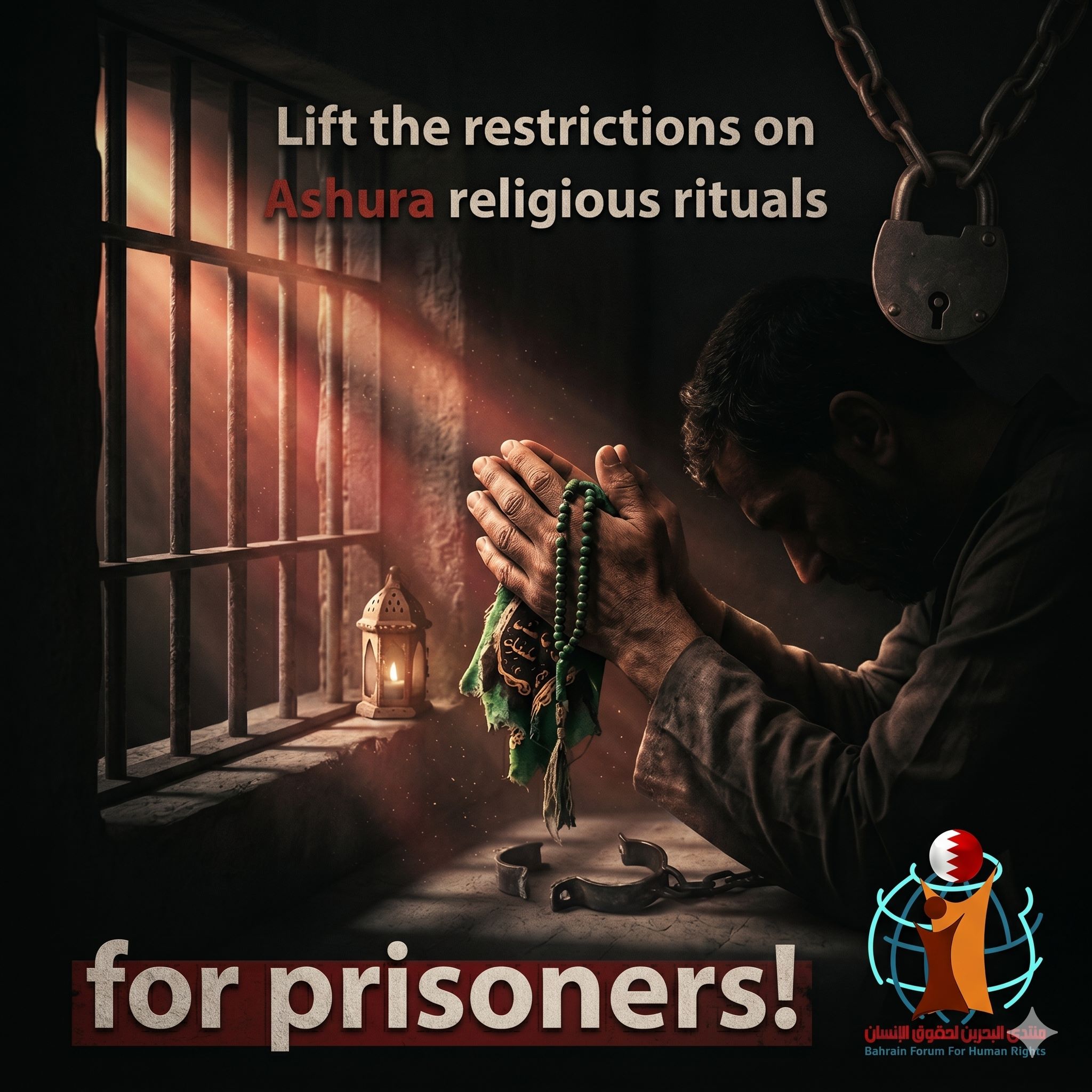
Lift the Restrictions on Prisoners! The Bahrain Forum for Human Rights (BFHR) calls for the lifting of restrictions on religious rituals and warns of the deteriorating health of hunger-striking detainees. Two hundred detainees at the Dry Dock Prison in Bahrain are undergoing an open-ended hunger strike in what has become known as the "empty-stomach strike." This strike is in protest against the restrictions imposed on their right to commemorate the religious rituals of Ashura, both individually and collectively.
BFHR expresses its deep concern over the conditions of the hunger-striking detainees, whose protest comes in response to being denied the right to practice their Ashura religious rituals, even inside locked cells. BFHR notes that this clampdown was preceded by depriving detainees of their religious books in general, and supplication books (Duaa) in particular, in addition to the limited availability of copies of the Holy Quran inside the prison buildings.
BFHR believes that the authorities' practices constitute a blatant violation of the Kingdom of Bahrain's international obligations as a state party to the International Covenant on Civil and Political Rights (ICCPR). Article 18 of the Covenant guarantees the right to freedom of religion and belief, including the freedom to manifest religious rituals individually and collectively. Furthermore, Article 10 of the same Covenant stipulates that all persons deprived of their liberty shall be treated with humanity and with respect for their inherent dignity.
These restrictions also conflict with the United Nations Standard Minimum Rules for the Treatment of Prisoners, known as the "Nelson Mandela Rules," which serve as the most crucial international reference for evaluating detention conditions and the treatment of prisoners. Depriving prisoners of the right to practice their religious rituals cannot be treated as a mere internal organizational measure; rather, it is an infringement on a fundamental right guaranteed under international human rights law.
Consequently, BFHR emphasizes that imposing arbitrary restrictions on religious practices inside prisons without a necessary or proportionate basis violates the principles of international human rights law and may constitute a form of discrimination based on belief.
Therefore, BFHR warns of the serious deterioration in the health of the hunger-striking detainees, holds the Bahraini authorities fully responsible for their physical and psychological safety, emphasizes the right of all prisoners of conscience to immediate and unconditional release, and demands that all restrictions on religious rituals be immediately lifted and that all detainees be guaranteed the necessary healthcare to preserve their lives and personal dignity. Based on the above, BFHR demands that the Government of Bahrain:
1. Immediately and unconditionally release all prisoners of conscience.
2. Immediately halt all restrictions imposed on the practice of religious rituals inside prisons.
3. Respond urgently to the demands of the hunger-striking prisoners and ensure they receive the necessary medical care.
4. Align prison policies and practices with international standards, including the ICCPR and the Nelson Mandela Rules.
5. Provide copies of the Holy Quran and the religious materials necessary for rituals inside detention facilities, and refrain from any punitive or retaliatory measures against prisoners for peacefully exercising their religious rights. In conclusion, BFHR calls upon the international community and relevant United Nations mechanisms to take urgent action to pressure the Bahraini authorities to protect the lives of the hunger-striking detainees and guarantee their religious rights inside prison, through:
1. The intervention of both the Special Rapporteur on freedom of religion or belief and the Special Rapporteur on torture and other cruel, inhuman or degrading treatment or punishment, to assess the impact of these restrictions on the detainees.
2. Documenting violations related to religious freedom inside prisons, monitoring and documenting the health status of the hunger strikers, and advocating for the provision of immediate, independent medical care for them.
3. Obligating the Bahraini authorities to guarantee the right of all prisoners to practice their religious rituals without discrimination, including holding congregational prayers and commemorating events and rituals associated with their beliefs, under appropriate practical arrangements. |