|
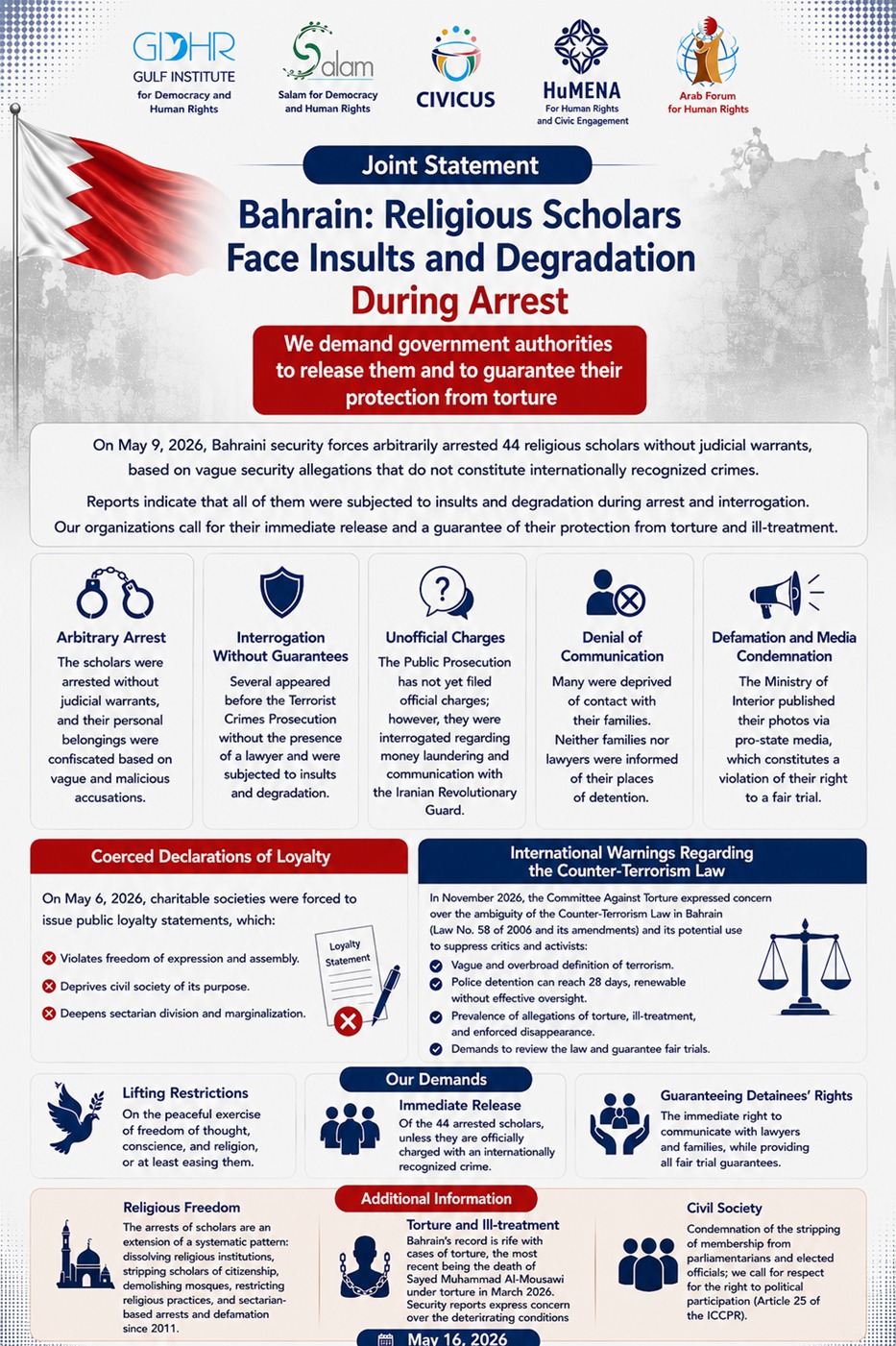
15 May 2026 Bahrain: Religious scholars are subjected to humiliation and degradation during their arrest; ensure none face torture and to be released The Government of the Kingdom of Bahrain must immediately and unconditionally release the religious scholars arrested by Bahraini security forces across the Kingdom on May 9, 2026, especially since it has not presented any evidence to substantiate its claims or formally charged them with internationally recognized offenses. On the contrary, it has resorted to its usual practice of levelling malicious accusations in political cases, and since the authorities have not provided any evidence to support their claims, they must be released. The authorities have a duty to uphold their international obligations and ensure that none of the detainees are subjected to torture, cruel, inhuman, or degrading treatment or punishment. Reports received by our organizations indicate that Bahraini security forces in civilian clothing arbitrarily arrested most of the religious scholars without warrants, based on vague security claims that do not constitute internationally recognized crimes. The reports also state that officials confiscated their personal belongings, including electronic devices and religious, intellectual, and cultural books. According to credible information received by our organizations, on May 12th, a number of detained religious scholars appeared before the Public Prosecution's Terrorism Crimes Unit without legal representation. Some were brought in for interrogation with lawyers present, and these proceedings are still ongoing as of the date of this statement, May 15th. It was also reported that a number of lawyers representing some of the detainees requested to attend the Public Prosecution's interrogation sessions. The Public Prosecution deliberately contacted some lawyers only after midnight (2:00 AM Bahrain time), seemingly to give the impression that they had been contacted. We have also received credible testimonies indicating that all the religious scholars were subjected to severe humiliation and degradation during their arrest and interrogation. According to available information, the Public Prosecution has not yet formally charged them, but they were investigated on charges related to money laundering, organizing and belonging to a secret group, communicating with the Iranian Revolutionary Guard Corps (IRGC), and promoting the ideology of "Guardianship of the Islamic Jurist" (Velayat-e Faqih). Based on reports available as of the date of this statement, since the arrests of May 9, the authorities have allowed approximately twelve men brief contact with their families, while others have been permitted only to contact them to request personal belongings, and some have been completely denied any contact with their families. It appears that the authorities have not informed the families or their legal representatives of the whereabouts of the detainees, leaving many families deeply concerned for their safety. Official data from the Ministry of the Interior stated that it had arrested 44 individuals it claimed were linked to the IRGC noting that the cases were related to sympathy for Iranian attacks. Another report indicated that legal proceedings were underway, without specifying whether the individuals would face particular charges. The ministry asserted that their arrests were part of ongoing investigations into espionage and expressing support for Iranian attacks. As of the time of this statement, the government had not presented any objectively verifiable evidence to support its claims. Among the 44 arrested were two prominent scholars, Sheikh Mohammed Sanqour and Sheikh Ali al-Saddadi (see additional information below). As a state party to the UN Convention against Torture and Other Cruel, Inhuman or Degrading Treatment or Punishment, the Bahraini authorities must ensure the safety of each of the detainees. Article 27 of Law 58/2006, on Protecting Society from Terrorist Acts, the reported basis for the arrests stipulates that questioning of the detainee must take place within three days with a view to release or a judicially-permitted detention of up to 28 days or even six months. The use of prolonged pre-trial detention by the GoB, which chronically and routinely ill-treats detainees (see Further Information, below), enhances the pre-existing risk of ill treatment for the 44 detainees, especially since their detainment can be contextualised as an enforced disappearance or incommunicado detention. While they have not made a formal statement, Bahrain’s Public Prosecution is reported to have charged an unknown number of the men under Bahrain’s Anti-Terror Law, formally Law 58/2006, with Respect to Protecting Society from Terrorism Acts. Charges reportedly could include money laundering, membership of a proscribed organisation and links with Iran’s Revolutionary Guards. According to reports available at the time of writing, since the 9 May arrests, the Bahraini authorities permitted around a dozen of the men to briefly contact their homes; others were only permitted to contact family to request specific belongings or were not allowed to contact their families at all. The authorities do not appear to have informed families or legal representation of their choice where they are held. As a result, many families fear for the safety of these men. In relation to the arrests, one report stated that Bahrain’s Ministry of Interior “arrested 41 people it said were linked ?to Iran’s Revolutionary ?Guards (IRGC)” and that the cases “involved cases related to ?sympathy with Iranian attacks”. Another reported that “legal proceedings are under way against them” but that the ministry did not “list specific charges against the individuals, but said their arrests relate to earlier investigations into espionage and expressions of support for Iranian attacks”. The government did not and has not, at the time of writing, set out any objectively verifiable evidence to substantiate its assertions. In January 2026, the independent treaty body that assesses the GoB’s implementation of the treaty acknowledged national security concerns but expressed concern that: “[...] Anti-terrorism legislation, in particular the Act on the Protection of Society from Acts of Terrorism (Act No. 58 of 2006) (as amended in 2019), contains a definition of terrorism that is vague and overly broad and has reportedly been extensively used outside the scope of counter-terrorism to crack down on those critical of the Government. It is also concerned that persons suspected or accused of involvement in terrorist acts can be held in police custody for a maximum period of 28 days and that they have allegedly been held in custody for longer periods without charge. It is further concerned about allegations that persons accused of terrorism are often subjected to arbitrary arrest, unlawful detention, torture, ill-treatment and enforced disappearance and that court proceedings in terrorism cases often lack fundamental procedural safeguards to ensure fair trials [...].” The Committee against Torture (CaT) called on the GoB to review the definition of terrorism in Law 58/2007, as amended in 2019, to ensure it adheres to international law, and to ensure that anti-terrorism legislation is not used to restrict the exercise of the right to peaceful expression, assembly or association and other fundamental human rights.[1] The CaT urged the GoB to “Reduce the maximum length of time that a person suspected of terrorism can be held in police custody” and “ensure that any extension is limited to exceptional circumstances that are duly justified and provide for the judicial review of the lawfulness of the detention.” Echoing the concern of UN bodies, our organisations emphasise our alarm at the character of arrests and the threat that government security forces will conduct interrogations without the presence of legal counsel; that this could result in detainees being subjected to ill-treatment, torture, or coercion to sign forced confessions or statements. Following the arrests, the GoB’s Ministry of Interior and state-linked media platforms published and circulated photographs of the detainees across local, Gulf, and wider Arab media outlets in a manner implying their guilt. The government undermined their right to a fair and independent trial and jeopardised the integrity of any possible judicial proceedings. Bahraini government measures against Freedom of Religion or Belief Our organisations acknowledge the media-oriented steps taken by the Bahraini authorities, including the Minister of Interior, Rashid bin Abdullah al-Khalifa, in meeting pre-selected members of Bahrain’s majority Shi’a community. According to a 13 May 2026 report on the al-Bilad media platform, he rejected allegations that the arrest of religious leaders constituted an act against the Shi’a community, and declared that the Shi’a community form an “authentic component of the past, present and future of this country” and that the Constitution and laws do not distinguish between citizens. Our organisations, however, assert the right, protected under international law, of every individual to have conscientiously held beliefs and to express them peacefully. On 12 May 2026, the social media platform of Bahrain’s Ministry of Interior denounced a concept of Shi’a Islam called Welaya al-Faqih, by which a relatively small part of the Shi’a community accord primacy in religious and social thought to a specific religious leader, including former leaders of Iran. In line with international human rights standards, our organisations assert that transnational intellectual or religious affiliations do not, in and of themselves, constitute criminal offenses under the law and must not be used as grounds for prosecution, harassment, or criminalization unless accompanied by clearly defined criminal conduct established through fair and independent judicial proceedings. Any arrest conducted on the basis of this peaceful and conscientiously held belief would be arbitrary and contrary to Bahrain’s international human rights obligations. Anyone detained on this basis alone should be released immediately and unconditionally. Coercive inducement of declarations of loyalty restricts freedom of expression and association; compromises civil society Our organisations express alarm at government measures to induce or leverage public expressions of government support in state-linked media. On 6 May 2026, the collectivity of Bahrain’s registered charity sector stated that they (implicitly, as a whole): “Renew their pledge of allegiance and loyalty to His Majesty King Hamad bin Isa Al Khalifa, King of the Kingdom of Bahrain, and affirm their commitment to the regulations, bylaws, and decisions issued by His Majesty and the wise government, ensuring the safety of the nation and its citizens, and preserving the security and stability of our beloved homeland [...]”. Our organisations are concerned that this induced declaration erodes the object and purpose of charitable organisations and that, in general, other such declarations violate Article 19 of the International Covenant on Civil and Political Rights (ICCPR) that “Everyone shall have the right to hold opinions without interference” and that “Everyone shall have the right to freedom of expression [...]”. We are concerned that continued use of induced assertions, in a context of manufactured febrile social conditions, will aggravate sectarian division in Bahrain and further stigmatise communities. Accusations of disloyalty or, worse, vaguely worded allegations of criminal action against national security by religious leaders, will undermine social cohesion and pluralism in Bahrain. Many such figures hold significant religious, cultural, educational, spiritual, and community roles within society: the measures taken and overseen by the government risk deepening societal division, intensifying collective marginalization and resentment. We call on the government to create the conditions for social cohesion and unity, Specifically, we urge the GoB to: - Release the 44 detained religious leaders unless they are promptly charged with an internationally recognisable criminal offence;
- Guarantee detainees’ immediate access to legal counsel and family members and ensure full fair trial guarantees;
- End or at least ease restrictions on the peaceful exercise of the right to freedom of thought and opinion and the peaceful expression of conscientiously held beliefs.
Further information: freedom of religion, torture and civil society In relation to freedom of religion, Bahraini security forces’ arrests included two religious leaders, Mohammed Sanqour and Ali al-Sadadi, both often called the honorific title, ‘Sheikh’. Mohammed Sanqour, 58, is the leader of the al-Huda Centre for Islamic Studies and a leading cleric at the Imam al-Sadiq Mosque in Diraz, northwestern Bahrain. His works and lectures address jurisprudence (fiqh) and other features of faith and religion, but also aspects of current affairs, including national reconciliation and the humane treatment of prisoners. According to a 2023, Senior religious leader, Ali al-Sadadi reported lectures on jurisprudence, the place of ‘Ashoura and tenets of faith, alongside topics in current affairs, such as the issue of political-prisoners and a resolution of the country’s political crisis. In 2024, he reportedly urged the government to release prisoners of conscience, Anecdotal reports indicate that both men are known for their rationality,; The GoB’s arrest of the religious leaders occurred within a longstanding framework of restrictions targeting the religious freedoms of the Shi’a community in Bahrain. Previous measures have included the dissolution of the Islamic Scholars Council, the repeated arrest of its former president Sayed Majid Al-Mishaal, the revocation of the nationality of Sheikh Isa Qassim, the most prominent Shi’a religious authority in Bahrain, and his subsequent forced removal from Bahrain. Swathes of the Shi’a community perceive the arrests as a component of sectarian discrimination and persecution faced by Shi’a citizens in Bahrain since 2011, as manifested by the demolition of mosques, restrictions on religious practices and freedoms, arbitrary arrests, nationality revocations, prison sentences, deportations, and systematic policies of exclusion and marginalization. On torture and ill treatment, the GoB, on a chronic basis, routinely tortures or ill-treats detainees in pre-trial detention. The 23 November 2011 Report of the Bahrain Independent Commission of Inquiry (BICI) set out scores of instances of pre-trial torture and ill-treatment, while on 12 August 2024, the UN Special Rapporteur on torture and other cruel, inhuman or degrading treatment or punishment, the Special Rapporteur on the right to food and the Special Rapporteur on the right of everyone to the enjoyment of the highest attainable standard of physical and mental health issued an urgent appeal detailing “deteriorating conditions of detention of prisoners held in various buildings of the Jau prison [in Bahrain]”, which they deemed “to fall below international standards”, which “may severely affect prisoners’ health status, exacerbating fragility and vulnerability [...]”.[2] Our organisations express concern over reports of ill treatment and unfair procedures in the administration of justice in the case of Budoor Abdulhamid (Abdulhameed), a female detainee. One report stated that her trial was held in secret while other reports indicate that the authorities ill treated her and induced her to sign an involuntary confession. In relation to civil society, alongside the purported unanimity of the charitable sector - and a range of others’ reported ‘loyalty’, our organisations echo the concern over the arbitrary stripping of citizenship and revocation of the elected status of three parliamentarians. These measures violate Article 25 of the ICCPR that every Bahraini has “the right and the opportunity [...] to take part in the conduct of public affairs, directly or through freely chosen representatives” and “to vote and to be elected at genuine periodic elections which shall be by universal and equal suffrage and shall be held by secret ballot [...]” /end/
[2] See the Report of the Bahrain Independent Commission of Inquiry (BICI), 23 November 2011. See Chapter VI - Allegation of Human Rights Violations against the person, Section D: Treatment of Persons in Custody, on page 282, from paragraph 1181. See: https://www.bici.org.bh/BICIreportEN.pdf and United Nations - OHCHR - Special Procedures: Urgent Appeal, referenced UA BHR 4/2024, issued by the mandates of the (UN) Special Rapporteur on torture and other cruel, inhuman or degrading treatment or punishment; the Special Rapporteur on the right to food and the Special Rapporteur on the right of everyone to the enjoyment of the highest attainable standard of physical and mental health, 12 August 2024, at: https://spcommreports.ohchr.org/TMResultsBase/DownLoadPublicCommunicationFile?gId=29261 |