|
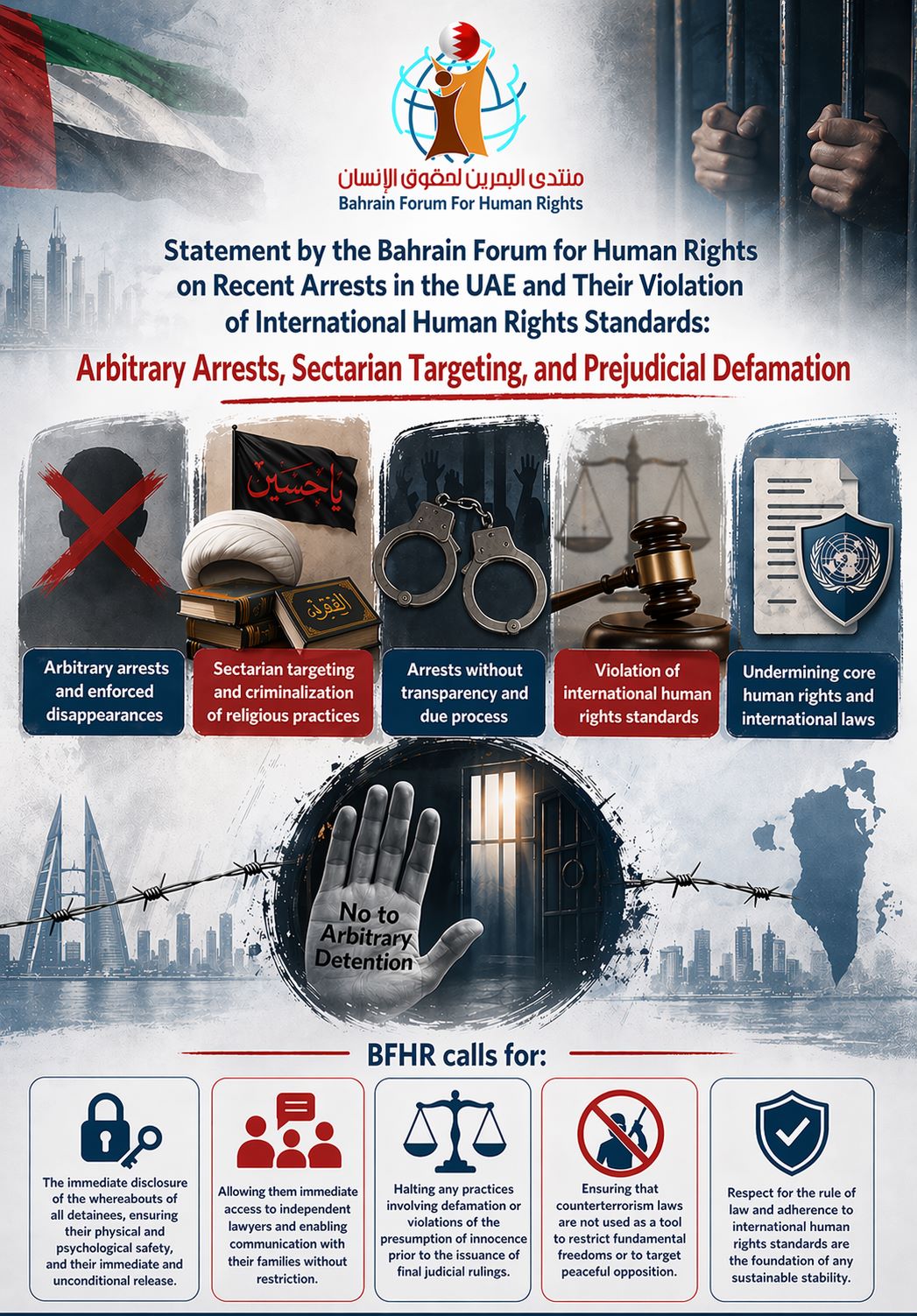
Statement by the Bahrain Forum for Human Rights on Recent Arrests in the UAE and Their Violation of International Human Rights Standards: Arbitrary Arrests, Sectarian Targeting, and Prejudicial Defamation
The Bahrain Forum for Human Rights (BFHR) condemned the announcement by the UAE State Security apparatus regarding the dismantling of what it described as a terrorist organization, and the subsequent arrests and security measures that followed. These actions targeted a number of individuals from the Shiite community, including Sheikh Ghadeer Mirza, Sheikh Ali Al-Hindi, Sayyid Sadiq Lari, Sayyid Mohammed Abdul Qaher, and Sayyid Adnan Al-Sayyid Abdullah Al-Ghurayfi. BFHR stated that these measures constitute sectarian targeting carried out in an environment lacking transparency and the basic guarantees of a fair trial.
BFHR emphasized that the protection of security and stability must not be used as a pretext to violate fundamental rights and freedoms guaranteed under international human rights treaties and conventions—foremost among them the rights to freedom of expression and belief, and the right to a fair trial before an impartial and independent judiciary. It further stressed that the measures taken, as announced, raise serious concerns regarding their compatibility with international standards, particularly with respect to the prohibition of arbitrary detention and the guarantees of due process.
BFHR also noted that the public disclosure of names and the defamation of detainees prior to the issuance of final judicial rulings by an impartial and independent court constitute a violation of the presumption of innocence. Such actions also contradict established legal principles that safeguard individuals’ reputations and rights until a final judgment is issued.
BFHR pointed to previous international human rights reports indicating a troubling pattern of using vague charges such as “undermining national unity” or “links to external parties,” which opens the door to restricting public freedoms, criminalizing peaceful activities, and interfering in religious financial rights. Cases have also been documented involving prolonged detention without trial, denial of access to legal counsel or family members, and trials that fall short of standards of independence and fairness.
These measures, BFHR argued, show clear indications of exceeding the legal framework and appear to fall within a context of sending sharp political, security, and sectarian messages amid ongoing tensions with Iran. This reinforces the impression that such actions are being used as tools within broader regional calculations. Moreover, the nature and timing of the charges reinforce the belief that the case is highly politicized, sectarian in character, and based on weak and inconsistent grounds.
BFHR also found it striking how the case has been framed, noting that purely religious elements—such as religious attire (the turban), Ashura banners, jurisprudential books, and images of religious authorities—have been presented as evidence of wrongdoing. This reflects clear sectarian targeting, weak legal foundations, and a presentation lacking professionalism, resembling the security theatrics often associated with non-democratic states.
The inclusion of well-known figures in this case without presenting clear and public evidence further heightens concerns about the nature of the measures taken and underscores the need for strict adherence to international human rights standards.
Accordingly, BFHR calls for:
• The immediate disclosure of the whereabouts of all detainees, ensuring their physical and psychological safety, and their immediate and unconditional release.
• Allowing them immediate access to independent lawyers and enabling communication with their families without restriction.
• Halting any practices involving defamation or violations of the presumption of innocence prior to the issuance of final judicial rulings.
• Ensuring that counterterrorism laws are not used as a tool to restrict fundamental freedoms or to target peaceful opposition.
BFHR concluded that respect for the rule of law and adherence to international human rights standards constitute the foundation of any sustainable stability, and that any breach of these principles risks undermining trust and deepening crises.
|